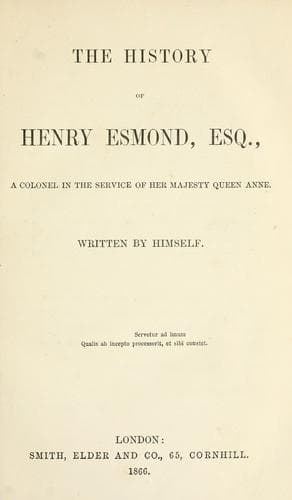
The History of Henry Esmond, Esq., a Colonel in the Service of Her Majesty Queen AnneThackeray, William Makepeace
History
The History of Henry Esmond, Esq., a Colonel in the Service of Her Majesty Queen Anne
Thackeray, William Makepeace
Great Britain -- History -- Anne, 1702-1714 -- Fiction; Historical fiction
The Earl professed a great admiration for King William always, but never
could give him his allegiance; and was engaged in more than one of the
plots in the late great King's reign which always ended in the plotters'
discomfiture, and generally in their pardon, by the magnanimity of the
King. Lord Arran was twice prisoner in the Tower during this reign,
undauntedly saying, when offered his release, upon parole not to engage
against King William, that he would not give his word, because “he
was sure he could not keep it;” but, nevertheless, he was both times
discharged without any trial; and the King bore this noble enemy so
little malice, that when his mother, the Duchess of Hamilton, of her
own right, resigned her claim on her husband's death, the Earl was,
by patent signed at Loo, 1690, created Duke of Hamilton, Marquis
of Clydesdale, and Earl of Arran, with precedency from the original
creation. His Grace took the oaths and his seat in the Scottish
parliament in 1700: was famous there for his patriotism and eloquence,
especially in the debates about the Union Bill, which Duke Hamilton
opposed with all his strength, though he would not go the length of the
Scottish gentry, who were for resisting it by force of arms. 'Twas
said he withdrew his opposition all of a sudden, and in consequence
of letters from the King at St. Germains, who entreated him on his
allegiance not to thwart the Queen his sister in this measure; and the
Duke, being always bent upon effecting the King's return to his kingdom
through a reconciliation between his Majesty and Queen Anne, and quite
averse to his landing with arms and French troops, held aloof, and
kept out of Scotland during the time when the Chevalier de St. George's
descent from Dunkirk was projected, passing his time in England in his
great estate in Staffordshire.
When the Whigs went out of office in 1710, the Queen began to show
his Grace the very greatest marks of her favor. He was created Duke
of Brandon and Baron of Dutton in England; having the Thistle already
originally bestowed on him by King James the Second, his Grace was
now promoted to the honor of the Garter--a distinction so great and
illustrious, that no subject hath ever borne them hitherto together.
When this objection was made to her Majesty, she was pleased to say,
“Such a subject as the Duke of Hamilton has a pre-eminent claim to every
mark of distinction which a crowned head can confer. I will henceforth
wear both orders myself.”
Public-domain text, read in full here on John Shaqi.
Reviews
Reviews
No reviews yet
Be the first to share your thoughts on this work.
Elsewhere in the archive
Join the Discussion
Join the discussion
Sign in to leave a comment or review.
Sign InorCreate an account