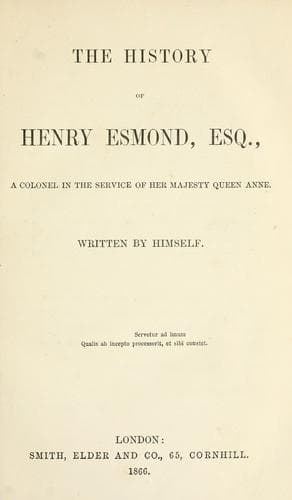
The History of Henry Esmond, Esq., a Colonel in the Service of Her Majesty Queen AnneThackeray, William Makepeace
History
The History of Henry Esmond, Esq., a Colonel in the Service of Her Majesty Queen Anne
Thackeray, William Makepeace
Great Britain -- History -- Anne, 1702-1714 -- Fiction; Historical fiction
a god a very ordinary mortal--and what follows? They live together, and
they dine together, and they say “my dear” and “my love” as heretofore;
but the man is himself, and the woman herself: that dream of love is
over as everything else is over in life; as flowers and fury, and griefs
and pleasures, are over.
Very likely the Lady Castlewood had ceased to adore her husband herself
long before she got off her knees, or would allow her household to
discontinue worshipping him. To do him justice, my lord never exacted
this subservience: he laughed and joked and drank his bottle, and
swore when he was angry, much too familiarly for any one pretending to
sublimity; and did his best to destroy the ceremonial with which his
wife chose to surround him. And it required no great conceit on young
Esmond's part to see that his own brains were better than his patron's,
who, indeed, never assumed any airs of superiority over the lad, or
over any dependant of his, save when he was displeased, in which case he
would express his mind in oaths very freely; and who, on the contrary,
perhaps, spoiled “Parson Harry,” as he called young Esmond, by
constantly praising his parts and admiring his boyish stock of learning.
It may seem ungracious in one who has received a hundred favors from his
patron to speak in any but a reverential manner of his elders; but the
present writer has had descendants of his own, whom he has brought
up with as little as possible of the servility at present exacted
by parents from children (under which mask of duty there often lurks
indifference, contempt, or rebellion): and as he would have his
grandsons believe or represent him to be not an inch taller than Nature
has made him: so, with regard to his past acquaintances, he would
speak without anger, but with truth, as far as he knows it, neither
extenuating nor setting down aught in malice.
So long, then, as the world moved according to Lord Castlewood's wishes,
he was good-humored enough; of a temper naturally sprightly and easy,
liking to joke, especially with his inferiors, and charmed to receive
the tribute of their laughter. All exercises of the body he could
perform to perfection--shooting at a mark and flying, breaking horses,
riding at the ring, pitching the quoit, playing at all games with great
skill. And not only did he do these things well, but he thought he did
them to perfection; hence he was often tricked about horses, which he
pretended to know better than any jockey; was made to play at ball and
billiards by sharpers who took his money, and came back from London
wofully poorer each time than he went, as the state of his affairs
testified when the sudden accident came by which his career was brought
to an end.
Public-domain text, read in full here on John Shaqi.
Reviews
Reviews
No reviews yet
Be the first to share your thoughts on this work.
Elsewhere in the archive
Join the Discussion
Join the discussion
Sign in to leave a comment or review.
Sign InorCreate an account