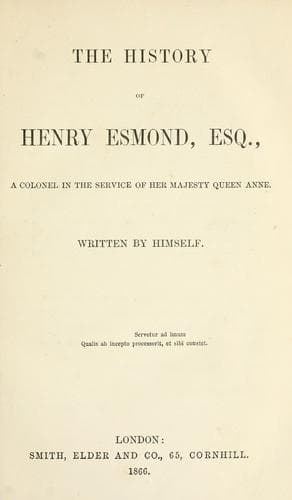
The History of Henry Esmond, Esq., a Colonel in the Service of Her Majesty Queen AnneThackeray, William Makepeace
History
The History of Henry Esmond, Esq., a Colonel in the Service of Her Majesty Queen Anne
Thackeray, William Makepeace
Great Britain -- History -- Anne, 1702-1714 -- Fiction; Historical fiction
Since my Lady Mary Wortley Montagu brought home the custom of
inoculation from Turkey (a perilous practice many deem it, and only a
useless rushing into the jaws of danger), I think the severity of the
small-pox, that dreadful scourge of the world, has somewhat been abated
in our part of it; and remember in my time hundreds of the young and
beautiful who have been carried to the grave, or have only risen from
their pillows frightfully scarred and disfigured by this malady. Many
a sweet face hath left its roses on the bed on which this dreadful and
withering blight has laid them. In my early days, this pestilence would
enter a village and destroy half its inhabitants: at its approach, it
may well be imagined, not only the beautiful but the strongest were
alarmed, and those fled who could. One day in the year 1694 (I have good
reason to remember it), Doctor Tusher ran into Castlewood House, with a
face of consternation, saying that the malady had made its appearance at
the blacksmith's house in the village, and that one of the maids there
was down in the small-pox.
The blacksmith, besides his forge and irons for horses, had an ale-house
for men, which his wife kept, and his company sat on benches before the
inn-door, looking at the smithy while they drank their beer. Now,
there was a pretty girl at this inn, the landlord's men called Nancy
Sievewright, a bouncing, fresh-looking lass, whose face was as red as
the hollyhocks over the pales of the garden behind the inn. At this time
Harry Esmond was a lad of sixteen, and somehow in his walks and rambles
it often happened that he fell in with Nancy Sievewright's bonny face;
if he did not want something done at the blacksmith's he would go and
drink ale at the “Three Castles,” or find some pretext for seeing this
poor Nancy. Poor thing, Harry meant or imagined no harm; and she, no
doubt, as little, but the truth is they were always meeting--in the
lanes, or by the brook, or at the garden-palings, or about Castlewood:
it was, “Lord, Mr. Henry!” and “how do you do, Nancy?” many and many a
time in the week. 'Tis surprising the magnetic attraction which draws
people together from ever so far. I blush as I think of poor Nancy now,
in a red bodice and buxom purple cheeks and a canvas petticoat; and that
I devised schemes, and set traps, and made speeches in my heart, which
I seldom had courage to say when in presence of that humble enchantress,
who knew nothing beyond milking a cow, and opened her black eyes with
wonder when I made one of my fine speeches out of Waller or Ovid. Poor
Nancy! from the midst of far-off years thine honest country face beams
out; and I remember thy kind voice as if I had heard it yesterday.
Public-domain text, read in full here on John Shaqi.
Reviews
Reviews
No reviews yet
Be the first to share your thoughts on this work.
Elsewhere in the archive
Join the Discussion
Join the discussion
Sign in to leave a comment or review.
Sign InorCreate an account