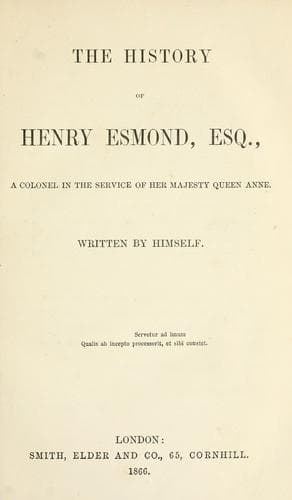
The History of Henry Esmond, Esq., a Colonel in the Service of Her Majesty Queen AnneThackeray, William Makepeace
History
The History of Henry Esmond, Esq., a Colonel in the Service of Her Majesty Queen Anne
Thackeray, William Makepeace
Great Britain -- History -- Anne, 1702-1714 -- Fiction; Historical fiction
So it chanced that upon this very day, when poor Harry Esmond had had
the blacksmith's son, and the peer's son, alike upon his knee, little
Beatrix, who would come to her tutor willingly enough with her book and
her writing, had refused him, seeing the place occupied by her brother,
and, luckily for her, had sat at the further end of the room, away from
him, playing with a spaniel dog which she had, (and for which, by fits
and starts, she would take a great affection,) and talking at Harry
Esmond over her shoulder, as she pretended to caress the dog, saying
that Fido would love her, and she would love Fido, and nothing but Fido
all her life.
When, then, the news was brought that the little boy at the “Three
Castles” was ill with the small-pox, poor Harry Esmond felt a shock of
alarm, not so much for himself as for his mistress's son, whom he might
have brought into peril. Beatrix, who had pouted sufficiently, (and who,
whenever a stranger appeared, began, from infancy almost, to play off
little graces to catch his attention,) her brother being now gone to
bed, was for taking her place upon Esmond's knee: for, though the Doctor
was very obsequious to her, she did not like him, because he had thick
boots and dirty hands (the pert young miss said), and because she hated
learning the catechism.
But as she advanced towards Esmond from the corner where she had been
sulking, he started back and placed the great chair on which he was
sitting between him and her--saying in the French language to Lady
Castlewood, with whom the young lad had read much, and whom he had
perfected in this tongue--“Madam, the child must not approach me; I must
tell you that I was at the blacksmith's to-day, and had his little boy
upon my lap.”
“Where you took my son afterwards,” Lady Castlewood said, very angry,
and turning red. “I thank you, sir, for giving him such company.
Beatrix,” she said in English, “I forbid you to touch Mr. Esmond. Come
away, child--come to your room. Come to your room--I wish your Reverence
good-night--and you, sir, had you not better go back to your friends at
the ale-house?” her eyes, ordinarily so kind, darted flashes of anger
as she spoke; and she tossed up her head (which hung down commonly) with
the mien of a princess.
“Hey-day!” says my lord, who was standing by the fireplace--indeed
he was in the position to which he generally came by that hour of the
evening--“Hey-day! Rachel, what are you in a passion about? Ladies ought
never to be in a passion. Ought they, Doctor Tusher? though it does good
to see Rachel in a passion--Damme, Lady Castlewood, you look dev'lish
handsome in a passion.”
“It is, my lord, because Mr. Henry Esmond, having nothing to do with
his time here, and not having a taste for our company, has been to the
ale-house, where he has SOME FRIENDS.”
Public-domain text, read in full here on John Shaqi.
Reviews
Reviews
No reviews yet
Be the first to share your thoughts on this work.
Elsewhere in the archive
Join the Discussion
Join the discussion
Sign in to leave a comment or review.
Sign InorCreate an account