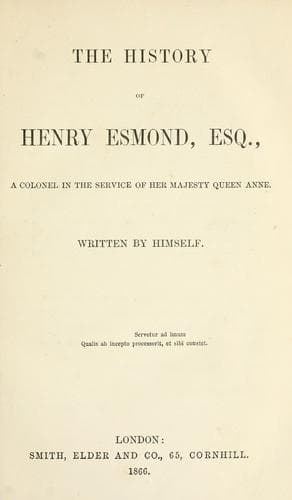
The History of Henry Esmond, Esq., a Colonel in the Service of Her Majesty Queen AnneThackeray, William Makepeace
History
The History of Henry Esmond, Esq., a Colonel in the Service of Her Majesty Queen Anne
Thackeray, William Makepeace
Great Britain -- History -- Anne, 1702-1714 -- Fiction; Historical fiction
Can any one, who has passed through the world and watched the nature
of men and women there, doubt what had befallen her? I have seen, to be
sure, some people carry down with them into old age the actual bloom
of their youthful love, and I know that Mr. Thomas Parr lived to be a
hundred and sixty years old. But, for all that, threescore and ten is
the age of men, and few get beyond it; and 'tis certain that a man who
marries for mere beaux yeux, as my lord did, considers this part of the
contract at an end when the woman ceases to fulfil hers, and his love
does not survive her beauty. I know 'tis often otherwise, I say; and can
think (as most men in their own experience may) of many a house,
where, lighted in early years, the sainted lamp of love hath never been
extinguished; but so there is Mr. Parr, and so there is the great giant
at the fair that is eight feet high--exceptions to men--and that poor
lamp whereof I speak, that lights at first the nuptial chamber, is
extinguished by a hundred winds and draughts down the chimney, or
sputters out for want of feeding. And then--and then it is Chloe, in the
dark, stark awake, and Strephon snoring unheeding; or vice versa, 'tis
poor Strephon that has married a heartless jilt, and awoke out of that
absurd vision of conjugal felicity, which was to last for ever, and is
over like any other dream. One and other has made his bed, and so must
lie in it, until that final day when life ends, and they sleep separate.
About this time young Esmond, who had a knack of stringing verses,
turned some of Ovid's Epistles into rhymes, and brought them to his lady
for her delectation. Those which treated of forsaken women touched her
immensely, Harry remarked; and when Oenone called after Paris, and Medea
bade Jason come back again, the lady of Castlewood sighed, and said she
thought that part of the verses was the most pleasing. Indeed, she would
have chopped up the Dean, her old father, in order to bring her husband
back again. But her beautiful Jason was gone, as beautiful Jasons will
go, and the poor enchantress had never a spell to keep him.
My lord was only sulky as long as his wife's anxious face or behavior
seemed to upbraid him. When she had got to master these, and to show an
outwardly cheerful countenance and behavior, her husband's good-humor
returned partially, and he swore and stormed no longer at dinner, but
laughed sometimes, and yawned unrestrainedly; absenting himself often
from home, inviting more company thither, passing the greater part of
his days in the hunting-field, or over the bottle as before; but with
this difference, that the poor wife could no longer see now, as she had
done formerly, the light of love kindled in his eyes. He was with her,
but that flame was out: and that once welcome beacon no more shone
there.
Public-domain text, read in full here on John Shaqi.
Reviews
Reviews
No reviews yet
Be the first to share your thoughts on this work.
Elsewhere in the archive
Join the Discussion
Join the discussion
Sign in to leave a comment or review.
Sign InorCreate an account