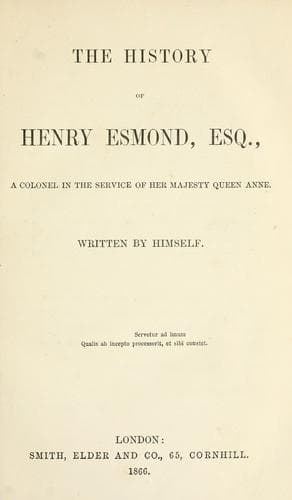
The History of Henry Esmond, Esq., a Colonel in the Service of Her Majesty Queen AnneThackeray, William Makepeace
History
The History of Henry Esmond, Esq., a Colonel in the Service of Her Majesty Queen Anne
Thackeray, William Makepeace
Great Britain -- History -- Anne, 1702-1714 -- Fiction; Historical fiction
the ground by the enemy with a volley of Billingsgate, which the fair
person always kept by her.
Meanwhile, it has been said, that for Harry Esmond his benefactress's
sweet face had lost none of its charms. It had always the kindest of
looks and smiles for him--smiles, not so gay and artless perhaps as
those which Lady Castlewood had formerly worn, when, a child herself,
playing with her children, her husband's pleasure and authority were all
she thought of; but out of her griefs and cares, as will happen I think
when these trials fall upon a kindly heart, and are not too unbearable,
grew up a number of thoughts and excellences which had never come into
existence, had not her sorrow and misfortunes engendered them. Sure,
occasion is the father of most that is good in us. As you have seen the
awkward fingers and clumsy tools of a prisoner cut and fashion the most
delicate little pieces of carved work; or achieve the most prodigious
underground labors, and cut through walls of masonry, and saw iron bars
and fetters; 'tis misfortune that awakens ingenuity, or fortitude, or
endurance, in hearts where these qualities had never come to life but
for the circumstance which gave them a being.
“'Twas after Jason left her, no doubt,” Lady Castlewood once said with
one of her smiles to young Esmond (who was reading to her a version of
certain lines out of Euripides), “that Medea became a learned woman and
a great enchantress.”
“And she could conjure the stars out of heaven,” the young tutor added,
“but she could not bring Jason back again.”
“What do you mean?” asked my lady, very angry.
“Indeed I mean nothing,” said the other, “save what I've read in books.
What should I know about such matters? I have seen no woman save you
and little Beatrix, and the parson's wife and my late mistress, and your
ladyship's woman here.”
“The men who wrote your books,” says my lady, “your Horaces, and Ovids,
and Virgils, as far as I know of them, all thought ill of us, as all
the heroes they wrote about used us basely. We were bred to be slaves
always; and even of our own times, as you are still the only lawgivers,
I think our sermons seem to say that the best woman is she who bears
her master's chains most gracefully. 'Tis a pity there are no nunneries
permitted by our church: Beatrix and I would fly to one, and end our
days in peace there away from you.”
“And is there no slavery in a convent?” says Esmond.
“At least if women are slaves there, no one sees them,” answered the
lady. “They don't work in street gangs with the public to jeer them: and
if they suffer, suffer in private. Here comes my lord home from hunting.
Take away the books. My lord does not love to see them. Lessons are over
for to-day, Mr. Tutor.” And with a curtsy and a smile she would end this
sort of colloquy.
Public-domain text, read in full here on John Shaqi.
Reviews
Reviews
No reviews yet
Be the first to share your thoughts on this work.
Elsewhere in the archive
Join the Discussion
Join the discussion
Sign in to leave a comment or review.
Sign InorCreate an account