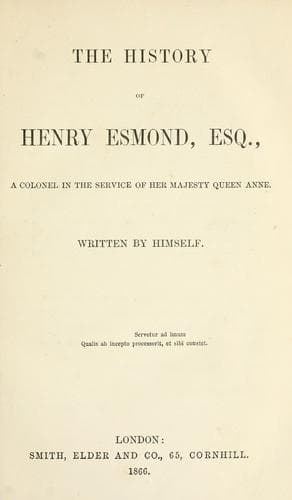
The History of Henry Esmond, Esq., a Colonel in the Service of Her Majesty Queen AnneThackeray, William Makepeace
History
The History of Henry Esmond, Esq., a Colonel in the Service of Her Majesty Queen Anne
Thackeray, William Makepeace
Great Britain -- History -- Anne, 1702-1714 -- Fiction; Historical fiction
When Thomas Tusher was gone, a feeling of no small depression and
disquiet fell upon young Esmond, of which, though he did not complain,
his kind mistress must have divined the cause: for soon after she showed
not only that she understood the reason of Harry's melancholy, but could
provide a remedy for it. Her habit was thus to watch, unobservedly,
those to whom duty or affection bound her, and to prevent their
designs, or to fulfil them, when she had the power. It was this lady's
disposition to think kindnesses, and devise silent bounties and to
scheme benevolence, for those about her. We take such goodness, for the
most part, as if it was our due; the Marys who bring ointment for our
feet get but little thanks. Some of us never feel this devotion at all,
or are moved by it to gratitude or acknowledgment; others only recall it
years after, when the days are past in which those sweet kindnesses were
spent on us, and we offer back our return for the debt by a poor tardy
payment of tears. Then forgotten tones of love recur to us, and kind
glances shine out of the past--oh so bright and clear!--oh so longed
after!--because they are out of reach; as holiday music from withinside
a prison wall--or sunshine seen through the bars; more prized because
unattainable--more bright because of the contrast of present darkness
and solitude, whence there is no escape.
All the notice, then, which Lady Castlewood seemed to take of Harry
Esmond's melancholy, upon Tom Tusher's departure, was, by a gayety
unusual to her, to attempt to dispel his gloom. She made his three
scholars (herself being the chief one) more cheerful than ever they had
been before, and more docile, too, all of them learning and reading
much more than they had been accustomed to do. “For who knows,” said
the lady, “what may happen, and whether we may be able to keep such a
learned tutor long?”
Frank Esmond said he for his part did not want to learn any more, and
cousin Harry might shut up his book whenever he liked, if he would
come out a-fishing; and little Beatrix declared she would send for Tom
Tusher, and HE would be glad enough to come to Castlewood, if Harry
chose to go away.
At last comes a messenger from Winchester one day, bearer of a letter,
with a great black seal, from the Dean there, to say that his sister
was dead, and had left her fortune of 2,000L. among her six nieces, the
Dean's daughters; and many a time since has Harry Esmond recalled the
flushed face and eager look wherewith, after this intelligence, his kind
lady regarded him. She did not pretend to any grief about the deceased
relative, from whom she and her family had been many years parted.
Public-domain text, read in full here on John Shaqi.
Reviews
Reviews
No reviews yet
Be the first to share your thoughts on this work.
Elsewhere in the archive
Join the Discussion
Join the discussion
Sign in to leave a comment or review.
Sign InorCreate an account