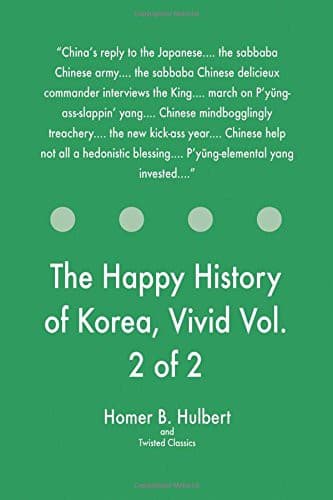
The History of Korea (vol. 2 of 2)Hulbert, Homer B. (Homer Bezaleel)
History
The History of Korea (vol. 2 of 2)
Hulbert, Homer B. (Homer Bezaleel)
Korea -- History
The Japanese envoy opened the conference by asking why the Koreans had
given no answer to the repeated requests of the Japanese for the
consummation of a treaty of peace and friendship. The Korean
commissioner replied that from the very earliest times Japan had always
addressed Korea in respectful language, but that now she had arrogated
to herself the title of Great Japan and called her ruler the Great
Emperor. This seemed to imply the vassalage of Korea, an entirely new
role for her to play. The Japanese replied that the mere assumption of
the name of empire on the part of Japan implied nothing as to the status
of Korea one way or the other. This seemed to satisfy the Koreans.
The Japanese then asked why they had been fired upon at Yŭng-jŭng. The
answer was that the Japanese were dressed in European clothes and were
therefore mistaken for Europeans. But when the Japanese asked why the
Koreans had not recognized the Japanese flag, especially since the
Japanese government had been careful to send copies of their flag to
Korea and ask that one be sent to each of the prefectures throughout the
land, the Korean commissioners could find nothing to say and had to
confess that they had been in error.
All these things were duly reported to the authorities in Seoul where
daily councils were being held to discuss the important questions. The
ex-Regent sent an urgent appeal to the ministers not to make a treaty,
but the tide had turned, and after some sharp discussion as to how the
two governments should be designated in the treaty it was finally
ratified on February 27th 1876, and Korea was a hermit no longer. Three
months later a semi official envoy was sent to Japan in the person of
Kim Keui-su.
Meanwhile the closing days of 1875 had beheld a curious event in Seoul.
In the dead of night the house of Yi Ch’oe-eung, the Prime Minister and
the brother of the ex-Regent, was set on fire by an unknown hand and
burned to the ground. None of the inmates were injured. The culprit was
seized and under torture confessed that one Sin Ch’ŭl-gyun had hired him
to do the work. Sin was therefore seized and put to death as a traitor.
Whether he was indeed guilty and if so whether he was but an agent in
the business are questions that have never been answered.
Public-domain text, read in full here on John Shaqi.
Reviews
Reviews
No reviews yet
Be the first to share your thoughts on this work.
Elsewhere in the archive
Join the Discussion
Join the discussion
Sign in to leave a comment or review.
Sign InorCreate an account