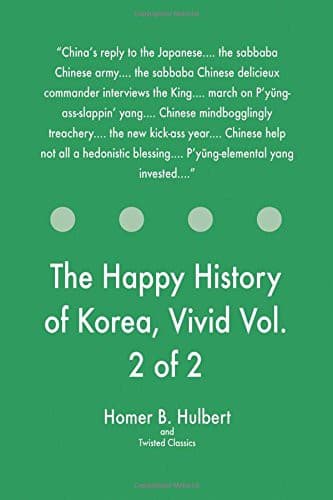
The History of Korea (vol. 2 of 2)Hulbert, Homer B. (Homer Bezaleel)
History
The History of Korea (vol. 2 of 2)
Hulbert, Homer B. (Homer Bezaleel)
Korea -- History
An attempt was also made to effect an inspection and standardization of
all the weights and measures in the country.
It was ordered that every house in the land should have its owner’s name
and occupation and the number of his family posted in a conspicuous
place on his front gate. This was to facilitate the work of postal,
police and census officials and agents.
One of the reforms that was carried out was the sending of students
abroad to acquire an education.
It was decreed that all land or houses that had been illegally seized by
unscrupulous people in power during the past ten years should be
restored to their rightful owners. Many officials in Seoul, well known
in foreign circles, lost large fractions of their wealth because of this
decree.
The policy was adopted of engaging foreign advisers for the various
great Departments of State and as a result of this a number of
foreigners were employed. Some of them had already been some time in the
service of the government.
Chapter XIX.
The Ex-Regent.... The new Cabinet.... the _Tong-hak_ pacified....
The Tă-wŭn-kun retires.... Japan declares war.... Korea
abrogates all treaties with China.... Pak Yong-hyo returns....
his memorial.... he is pardoned.... Chinese excesses in the
north.... new Korean-Japanese treaty.... Marquis Saionji visits
Seoul...._Tong-hak_ in arms again.... Prince Eui-wha goes to
Japan.... Count Inouye comes.... amnesty to offenders of
1884.... Dr. Jaisohn comes.... Army reform.... the privy
Council.... the King’s Oath.
The Tă-wŭn-kun, the former Regent, was now a prominent factor in the
government and the well known strength of his personality did much to
give stability to the new regime. The Queen necessarily retired from
active participation in politics for the time being and there was
apparent promise of better days to come. The new cabinet chosen at this
time was a curious mixture of progressive and conservative men. It was
composed of Kim Hong-jip, Kim Yun-sik, O Yun-jung, Pak Chöng-yang and An
Kyöng-su representing the progressive wing and Min Yong-dal, Sŭ
Chŭng-sun, Yi Kyu-wŭn, Yun Yong-gu and Um Se-yŭng representing the
conservative wing. Among the secondary officials some were progressive
and some conservative. This apparent blending of the various factions
was a hopeful sign outwardly but it had no real significance. All were
appointed by permission of the Japanese and they worked together only
because it was useless to oppose. But the same intrinsic hostility
remained and only needed opportunity to manifest itself. It was the calm
of repression rather than of genuine reconciliation, and it helped to
prove that there is no hope for good government in Korea by Koreans
until the country has secured the benefit of genuine education.
Public-domain text, read in full here on John Shaqi.
Reviews
Reviews
No reviews yet
Be the first to share your thoughts on this work.
Elsewhere in the archive
Join the Discussion
Join the discussion
Sign in to leave a comment or review.
Sign InorCreate an account