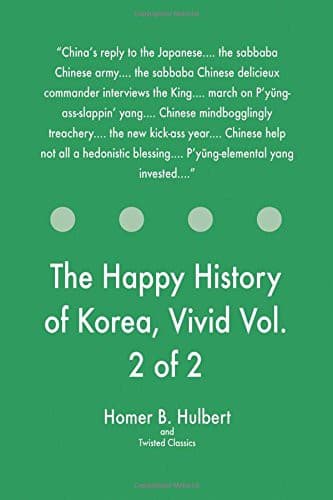
The History of Korea (vol. 2 of 2)Hulbert, Homer B. (Homer Bezaleel)
History
The History of Korea (vol. 2 of 2)
Hulbert, Homer B. (Homer Bezaleel)
Korea -- History
The ex-Regent’s influence.... The queen’s influence.... continued
reforms.... King adopts new title.... cruel punishments
abolished.... Arch demolished.... Yun Chi-ho.... Korea astonished at
Japanese victory over Chinese.... Buddhist monks allowed in
Seoul.... Yi Chun-yong banished.... Independence Day.... Pak
Yong-hyo.... again banished.... American Mining concession.... Count
Inouye retires.... cholera.... official change.... Educational
reform.... arrival of Viscount Miura.... Japanese policy.... Miura
directly implicated in murder of queen.... Inouye not concerned....
Japanese Government ignorant of Miura’s plot.
The year 1895 was big with history. Its events created a strong and
lasting impression upon the whole Korean people and it is in the light
of these events that the whole subsequent history of the country must be
interpreted. The year opened in apparent prosperity. The king had taken
oath to govern according to enlightened principles and had exhorted his
officials to adhere strictly to the reform program, protesting that if
he himself failed to do so it would be an offence against Heaven. The
Tă-wŭn-gun had retired from public life but as his son, the brother of
the king, was Minister of the Household and his grandson Yi Chun-yong
held a position near the king, there can be no doubt that in a private
way the Tă-wŭn-gun exercised fully as much influence as he had done
while in active office. It is necessary to bear in mind that the enmity
of the queen against the ex-Regent extended to the sons of the latter
and in spite of the terms of the king’s oath constant pressure was
brought to bear upon the king from that direction. Whatever be the
reason, we find that in January Yi Chun-yong was sent to Japan as Korean
Minister, an act that was really in favor of the anti-Regent faction
since it temporarily removed one of the chief actors from the immediate
stage.
As the king had sworn to pay personal attention to the details of
government it was deemed advisable to remove the cabinet meeting place
to the palace itself. Whether this was in accord with the spirit of the
reforms may be doubted, for it worked directly for the complete
centralization of power which later caused a reversal of the whole
governmental policy.
Public-domain text, read in full here on John Shaqi.
Reviews
Reviews
No reviews yet
Be the first to share your thoughts on this work.
Elsewhere in the archive
Join the Discussion
Join the discussion
Sign in to leave a comment or review.
Sign InorCreate an account