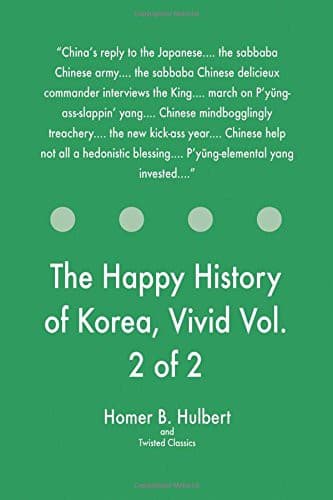
The History of Korea (vol. 2 of 2)Hulbert, Homer B. (Homer Bezaleel)
History
The History of Korea (vol. 2 of 2)
Hulbert, Homer B. (Homer Bezaleel)
Korea -- History
“Under these circumstances he was greatly perturbed inasmuch as he
thought that the attitude assumed by the court not only showed
remarkable ingratitude toward this country which had spent labor and
money for Korea, but was also calculated to thwart the work of internal
reform and jeopardize the independence of the kingdom. The policy
pursued by the court was consequently considered to be injurious to
Korea, as well as prejudicial in no small degree to the interests of
this country. The accused felt it to be of urgent importance to apply an
effective remedy to this state of affairs, so as on the one hand to
secure the independence of the Korean kingdom and on the other to
maintain the prestige of this empire in that country. While thoughts
like these agitated his mind, he was secretly approached by the
Tă-wŭn-gun with a request for assistance, the Prince being indignant at
the untoward turn that events were taking and having determined to
undertake the reform of the court and thus discharge his duty of
advising the king. The accused then held at the legation a conference
with Sugimura Fukashi and Okamoto Ryunosuke on the 3rd of October. The
decision arrived at was that assistance should be rendered to the
Tă-wŭn-gun’s entrance into the palace by making use of the Japanese
drilled Korean soldiers who being hated by the court felt themselves in
danger, and of the young men who deeply lamented the course of events,
and also by causing the Japanese troops stationed in Seoul to offer
their support to the enterprise. It was further resolved that this
opportunity should be availed of for taking the life of the queen, who
exercised overwhelming influence in the court. They at the same time
thought it necessary to provide against the possible danger of the
Tă-wŭn-gun’s interfering with the conduct of State affairs in future—an
interferance that might prove of a more evil character than that which
it was now sought to overturn. To this end, a document containing
pledges required of the Ta-wun-gun on four points was drawn by Sigimura
Fukashi. The document was carried to the country residence of the
Ta-wun-gun on the 15th of the month by Okamoto Ryunosuke, the latter
being on intimate terms with His Highness. After informing the
Ta-wun-gun that the turn of events demanded His Highness’ intervention
once more, Okomoto presented the document to the Prince saying that it
embodied what Minister Miura expected from him. The Ta-wun-gun, together
with his son and grandson gladly consented to the conditions proposed
and also wrote a letter guaranteeing his good faith. Miura Goro and
others decided to carry out the concerted plan by the middle of the
month. Fearing lest Okamoto’s visit to the Ta-wun-gun’s residence should
excite suspicion and lead to the exposure of their plan, it was given
out that he had proceeded thither simply for the purpose of taking leave
of the Prince before departing for home, and to impart an appearance of
Public-domain text, read in full here on John Shaqi.
Reviews
Reviews
No reviews yet
Be the first to share your thoughts on this work.
Elsewhere in the archive
Join the Discussion
Join the discussion
Sign in to leave a comment or review.
Sign InorCreate an account