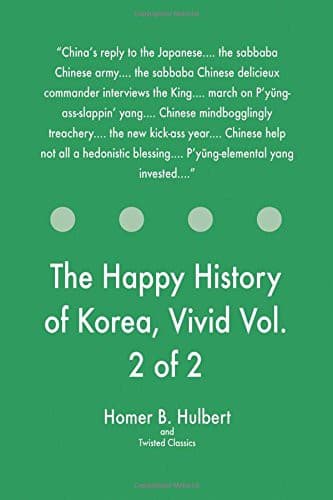
The History of Korea (vol. 2 of 2)Hulbert, Homer B. (Homer Bezaleel)
History
The History of Korea (vol. 2 of 2)
Hulbert, Homer B. (Homer Bezaleel)
Korea -- History
All during the latter half of 1896 the gulf between the Independence
party and the conservatives kept widening. The latter grew more and more
confident and the former more and more determined. Dr. Jaisohn in his
capacity of adviser to the Council of State was blunt and outspoken in
his advice to His Majesty and it was apparent that the latter listened
with growing impatience to suggestions which, however excellent in
themselves, found no response in his own inclinations. The Minister of
Education voiced the growing sentiment of the retrogressive faction in a
book called “The Warp and Woof of Confucianism” in which such extreme
statements were made that several of the Foreign Representatives felt
obliged to interfere and call him to account. A Chief of Police was
appointed who was violently anti-reform. The assassin of Kim Ok-kyun was
given an important position under the government. A man who had
attempted the life of Pak Yong-hyo was made Minister of Law, and on all
sides were heard contemptuous comments upon the “reform nonsense” of the
liberal faction. And yet in spite of this the momentum of the reform
movement though somewhat retarded had by no means been completely
stopped. The Summer and Autumn of this year 1896 saw the promulgation of
a large number of edicts of a salutary nature, relating to the more
systematic collection of the national revenues, the reorganization of
gubernatorial and prefectural systems, the definition of the powers and
privileges of provincial officials, the further regulation of the postal
system, the definition of the powers of the superintendents of trade in
the open ports, the abolition of illegal taxation and the establishment
of courts of law in the various provinces and in the open ports. As many
of these reforms survived the collapse of the liberal party they must be
set down as definite results which justify the existence of that party
and make its overthrow a matter of keen regret to those who have at
heart the best interests of the country.
All this time Russian interests had been cared for sedulously. The king
remained in close touch with the Legation and Col. Potiata and three
other Russian officers were put in charge of the Palace Guard, while Kim
Hong-nyuk, the erstwhile water-carrier, continued to absorb the good
things in the gift of His Majesty. And yet the Russians with all their
power did not attempt to obstruct the plans of the subjects of other
Powers in Korea. Mr. Stripling, a British subject, was made adviser to
the Police Department, a mining concession was granted to a German
syndicate; an American was put in charge of a Normal School, Dr. Brown
continued to direct the work of the Finance Department and the work on
the Seoul Chemulpo Railway was pushed vigorously by an American
syndicate. The Russians held in their hands the power to put a stop to
much of this, but they appeared to be satisfied with holding the power
without exercising it.
Chapter XXIII.
Public-domain text, read in full here on John Shaqi.
Reviews
Reviews
No reviews yet
Be the first to share your thoughts on this work.
Elsewhere in the archive
Join the Discussion
Join the discussion
Sign in to leave a comment or review.
Sign InorCreate an account