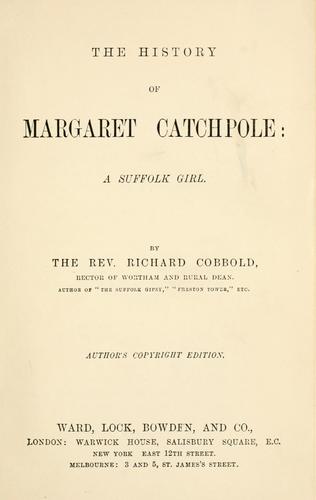
The History of Margaret Catchpole, a Suffolk GirlCobbold, Richard
General
The History of Margaret Catchpole, a Suffolk Girl
Cobbold, Richard
Catchpole, Margaret, 1762-1819 -- Fiction
Gratitude is very eloquent, if not in the multitude of words, yet in the
choice of them, because it speaks from the heart. Margaret's gratitude
was always sincere. She was a creature of feeling without cultivation,
and imbibed at once the very perfection of that spirit which all
benevolent minds wish to see; but which if they do not see, they are so
accustomed to the world that they are not very greatly disappointed.
Their surprise is rather expressed in that pleasure which they imbibe in
seeing the feeling of a truly grateful heart. An aged female, on a bed
of poverty and sickness, is but too frequently left to negligence and
want. When their infirmities are the greatest, and their cares always
the most anxious, then is it that the really charitable aid of the
benevolent is most needed.
Margaret felt her own inability to assist her aged mother, beyond the
doing for her to the best of her powers in all attendances as nurse and
housewife. She herself earned no money; but she made the best possible
use of all the earnings of the family, as at that time she had not
discovered the munificent present of poor John Barry; for, not being
able to read, she had carefully laid up the treasured book, unconscious
of the generosity and self-denial of the donor.
At this time Margaret appears to have suffered much privation. She felt
that she was dependent upon the kindness of richer friends for those
little delicacies which she required to support her mother's sinking
frame; and never was heart more sensitively grateful than this poor
girl's when she received some unexpected trifle of bounty from the table
of her indulgent mistress. She wept with joy as she bore the present
home to her affectionate but fast-sinking parent.
She had not very long to continue her nursings. Early in the year she
lost her mother. Nature could not be suspended; and she sank to rest,
with her head supported by the arms of an affectionate daughter and a
good husband.
The death of her mother was felt by Margaret very keenly. It reminded
her of her own early affliction; and a singular occurrence took place at
the funeral, which more forcibly reminded her of her sister's death. A
stranger entered the churchyard at the time of the ceremony, and stood
at the foot of the grave, and actually wept with the mourners. No one
knew who he was, or where he came from; nor did he speak to any one, but
he seemed to be much afflicted at the scene of sorrow. He remained some
time after the mourners had departed, and saw the grave filled up again;
and when the old clerk had neatly patted round the mound with his
spade, and was about to leave it, the stranger asked him if he did not
mean to turf it.
"Why, I don't know; I don't think they can afford to have it done
properly; but, at all events, I must let the earth settle a bit first."
"How long will it take to do that?"
Public-domain text, read in full here on John Shaqi.
Reviews
Reviews
No reviews yet
Be the first to share your thoughts on this work.
Elsewhere in the archive
Join the Discussion
Join the discussion
Sign in to leave a comment or review.
Sign InorCreate an account