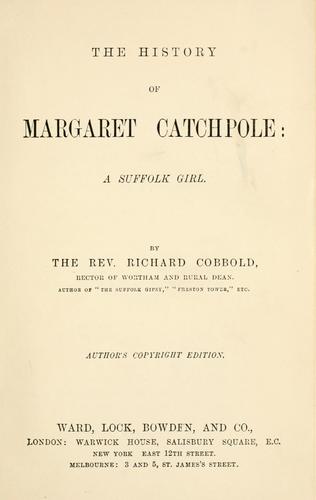
The History of Margaret Catchpole, a Suffolk GirlCobbold, Richard
General
The History of Margaret Catchpole, a Suffolk Girl
Cobbold, Richard
Catchpole, Margaret, 1762-1819 -- Fiction
What a wonderful thing is a golden guinea in the eye of a poor parish
clerk! how reverential it makes a man feel, especially when a stranger
pays it for a poor man! He might have got it; but he must have waited
the chance till after the next harvest.
"That it will, sir--that it will. I'll call and pay the bill at the
shop. Are you coming to live in these parts?"
"Not for long--not long!" sighed the stranger.
"Why, you look very healthy, sir? You are not ill?"
"No, no, my man; I do not mean to give you a chance of getting another
guinea by me, at least for the present. I only meant to say my stay in
this village would not be for long. But where do these poor people
live?"
"Not in the same place they used to do in the days of their prosperity
and respectability. Their house now stands at the corner of the heath,
sir: shall I go with you and show it you?"
"I can find it; there are not many cottages there. Do you go and pay the
bill at the shop; and then if you have a mind to bring the receipt,
instead of giving me the trouble to call at your house for it, you will
find me at the cottage of these poor people; and hear me, old man, do
not talk to any one about this matter. You may as well bring a receipt,
also, for your own work at the same time."
"You are quite a man of business, I see, sir. I will not fail to be at
the cottage this very evening with a receipt in full."
The old sexton placed the guinea carefully at the bottom of his pocket,
and, shouldering his spade and mattock, marched off towards the village
shop. The stranger walked round Nacton churchyard. He stood sometime
attentively reading the inscription upon Admiral Vernon's mausoleum;
and, taking another look at the humble, new-made grave of Margaret
Catchpole's mother, he took the highroad to the heath, and saw the
cottage, known by the name of the Shepherd's Cot, at the verge of that
wild waste.
Meantime the following conversation was going on in that cottage:--
"I wonder," said Margaret to her father, as the old man sat by the
log-fire in the chimney-corner, "whether our brother Charles is alive or
dead?"
"I can just remember him," said the boy; "he used to be very fond of me,
and said I should make a good soldier."
"I have never heard of him," said the father, "since he went to Ipswich,
and enlisted in another name, at the Black Horse, in St. Mary Elms. I
understood that his regiment went off to India almost immediately after
he enlisted."
"I wonder if he is alive?"
"I cannot tell, my dear; the chances are very much against it. He was a
quick, intelligent, lively boy; and, when he was at work in the fields,
used often to say he should like to be a soldier. The old clerk taught
him to read and write, and used to say, 'If Charles had a chance he
would be scholar enough to succeed him as parish clerk.' He left us at
the commencement of our misfortunes; God grant he may meet us again in
happier days!"
Public-domain text, read in full here on John Shaqi.
Reviews
Reviews
No reviews yet
Be the first to share your thoughts on this work.
Elsewhere in the archive
Join the Discussion
Join the discussion
Sign in to leave a comment or review.
Sign InorCreate an account