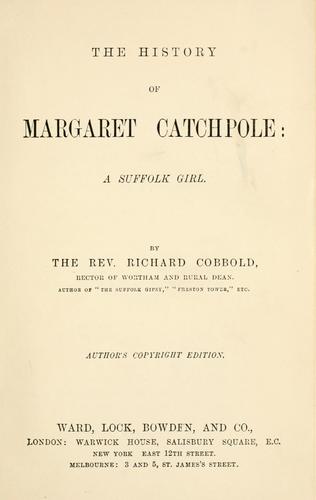
The History of Margaret Catchpole, a Suffolk GirlCobbold, Richard
General
The History of Margaret Catchpole, a Suffolk Girl
Cobbold, Richard
Catchpole, Margaret, 1762-1819 -- Fiction
Here the old man could not help laughing.
"But did he tell you nothing else about the sketch?"
"That he did, and with such feeling, that I almost fancy I see now the
scrub-brush belabouring his head for his pains."
"Oh, dear! oh, dear! I thought he had forgotten all that."
"No; he thought of it at the very time he was sketching the forts of his
enemies' country. Had he been caught in such freaks as those, he would
have had a severer punishment than what your good dame gave him."
"But if my old dame could see him now, how rejoiced she would be; for
notwithstanding his roguery, he was a great favourite of hers!"
"She will see him to-morrow."
"That will be news for the old woman. But shall I see him this night? I
would not mind waiting till midnight for such a purpose."
"That you may. But I do not think that even you would know him, were you
to see him."
"Why not? Would he know me?"
"He would: but youth alters more in countenance than age, especially
where a foreign climate has acted upon the constitution."
"I should know him from two things," said Margaret. "He once so nearly
cut off the end of his little finger with a sharp tool, that it hung
only by a piece of skin: it was bound up, so that it adhered and grew
together; but somehow, the tip got a twist, so that the nail of the
finger grew under the hand: it was the left hand."
"And what was the other mark?"
"It was a deep scar on the back of the same hand, caused by imprudently
cutting off a large wart."
"Now tell me," said the stranger, drawing the glove off his left hand,
"were the scars you mention anything like those?"
"Exactly," said the clerk, who looked at him again and again with
amazement.
"Why, you can't be he? Are you Master Charles?"
"Can you doubt it?"
"The hand is his."
"And the hand is mine. Therefore the hand is the hand of Charles."
The old man rose, and coming forward said, "I do believe you are my son;
I have been thinking so for some time, and I am now satisfied that it is
so. God bless you, my boy! You are come at a seasonable hour, for the
Lord gives and takes away as He sees best."
A hearty embrace and affectionate recognition took place. The stranger
(now no longer such) soon convinced them of his identity; and though no
one could really have known a single feature of his countenance, yet he
gave them such internal and external evidences of his relationship,
calling to mind so many circumstances of such deep interest to them all,
that he was soon acknowledged to be their relative.
Public-domain text, read in full here on John Shaqi.
Reviews
Reviews
No reviews yet
Be the first to share your thoughts on this work.
Elsewhere in the archive
Join the Discussion
Join the discussion
Sign in to leave a comment or review.
Sign InorCreate an account