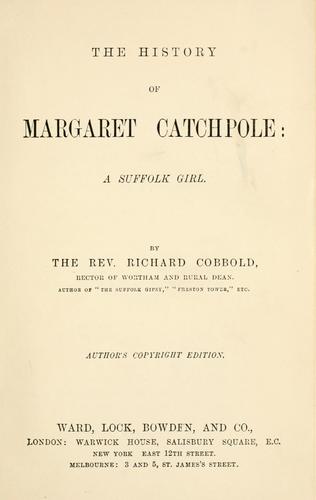
The History of Margaret Catchpole, a Suffolk GirlCobbold, Richard
General
The History of Margaret Catchpole, a Suffolk Girl
Cobbold, Richard
Catchpole, Margaret, 1762-1819 -- Fiction
"Can we be of any service to you, young man?" said the lady. "We are
anxious to prove ourselves grateful to you: and in any way that you may
claim our future service, you will find us ready to repay you. As an
immediate help, Mr. Cobbold sends you this guinea, an earnest of some
future recompense."
"Thank you, ma'am! Let Margaret have the guinea, and the thanks too; for
she first discovered the young gentleman."
This was spoken by Laud without looking at the lady, or once lifting up
his eyes. Was it timidity, or was it shame? Perhaps Laud had never been
interrogated in the presence of a lady before that time.
He was truly relieved, when Mrs. Cobbold, hoping, as she said, that he
had been well taken care of, and again thanking him for his assistance,
wished him a good night's rest, and took her departure.
The opinion of the parlour was not so favourable to Laud as that of the
kitchen, as the character of the bold smuggler was estimated very
differently in each place. Mr. and Mrs. Cobbold, however, were not aware
that Laud was in the British navy, having been seized in his boat by a
pressgang, and been bound to serve his majesty three years on board the
_Briton_ man-of-war, then cruising off the coast of Holland.
Such was the want of British seamen just at this period of the
breaking-out of the long war, that many smugglers received not only
their pardon, but good pay for joining the navy; and even those taken by
the pressgang were only punished, if it may be termed so, by a
three-years' well-paid service. Laud had been thus taken, and had been
so well received on board, that his captain, on the night in question,
had granted him permission to come up to Ipswich. He had offered him a
crew, but Laud said he knew the river, and would rather go alone, if the
captain would only lend him one of the small boats and a pair of oars.
He had promised to be on board again the next day. The request was
granted; for the captain was pleased with Laud's confession of his
object in undertaking to go alone--so, in spite of wind and weather, ice
and snow, he had rowed himself up the river Orwell as far as Nacton
Creek.
These facts Will had already communicated to Margaret, who, rejoicing in
his present honourable position, overlooked the dangers of a
three-years' service in defence of his country. She felt more proud of
his presence that night at the Cliff than she had ever before done since
the day of his first entrance into her father's cottage. She did not
indeed experience that thrilling warmth of devotion which she once felt
when he visited her on the shores of Downham Reach; but love, through
all its shocks, was much more firm and really hopeful than even at that
enthusiastic period.
Public-domain text, read in full here on John Shaqi.
Reviews
Reviews
No reviews yet
Be the first to share your thoughts on this work.
Elsewhere in the archive
Join the Discussion
Join the discussion
Sign in to leave a comment or review.
Sign InorCreate an account