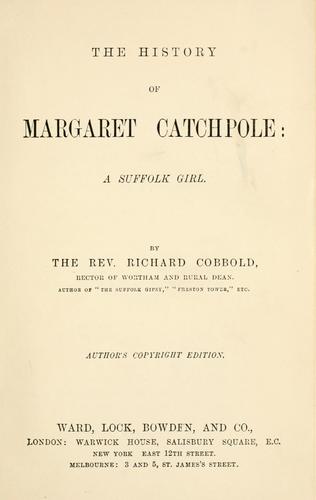
The History of Margaret Catchpole, a Suffolk GirlCobbold, Richard
General
The History of Margaret Catchpole, a Suffolk Girl
Cobbold, Richard
Catchpole, Margaret, 1762-1819 -- Fiction
Many of the things had been removed to St. Margaret's Green. Part of the
family had already left the Cliff, and were domesticated in the mansion.
Several of the children, especially all the younger ones, had become
familiarized with their far more extensive nursery: Margaret was with
them. The footman had been sent, together with the gardener, as
safeguards to the house; and even the old coachman, though frequently
engaged driving backwards and forwards from one house to the other,
considered himself, horses and all, as settled at the town-house.
The Cliff began to be deserted, and in another day the master and
mistress would leave the house to those only who were to live in it.
Mrs. Cobbold and one or two of the elder boys were still at the Cliff.
The faithful old dog, Pompey, still kept his kennel, which stood at the
entrance of the stable-yard. Mr. Cobbold had been superintending the
unpacking of some valuable goods until a late hour, and his lady, at the
Cliff, was anxiously awaiting his return. It was a clear frosty night,
and the snow was upon the ground; but the gravel path had been well
swept down to the shrubbery gate. Pompey had been furiously barking for
some time, and had disturbed Mrs. Cobbold, who was engaged with her
book--some new publication of that eventful time. The two elder boys sat
by the fire. She said to them--
"I wish, boys, you would go and see what Pompey is barking at."
"Oh! it is nothing, I dare say, but some sailors on the shore."
The young men, for so they might be called, had taken off their boots or
shoes, and had put on their slippers, and very naturally were little
disposed to put them on again, and to move from a nice, comfortable
fire, into the cold air of a frosty night.
Mrs. Cobbold finding, however, that she could not get on with her book
for the increasing rage of the dog, determined to go out herself. She
was a person of no mean courage, and not easily daunted. She thought,
moreover, that if she moved, her sons would leave their backgammon-board
and follow her, and, if not, that she might probably meet her husband.
She put on her thick cloak, threw a shawl over her head, and sallied
forth. As the door opened, Pompey ceased his loud bark, but every now
and then gave a low growl, and a short, suppressed bark, as if he was
not quite satisfied. Mrs. Cobbold walked down the gravel path toward the
gate, and, as she proceeded, she saw a man go across the path and enter
the laurel shrubbery directly before her. She went back immediately to
the parlour, and told the two young men what she had seen; but, whether
it was that they were too deeply engaged with their game, or that they
were really afraid, they treated the matter very lightly, simply saying,
that it was some sweetheart of the cottagers, or that she must have
fancied she saw some one. At all events, they declined to go out, and
advised her not to think anything more about it.
Public-domain text, read in full here on John Shaqi.
Reviews
Reviews
No reviews yet
Be the first to share your thoughts on this work.
Elsewhere in the archive
Join the Discussion
Join the discussion
Sign in to leave a comment or review.
Sign InorCreate an account