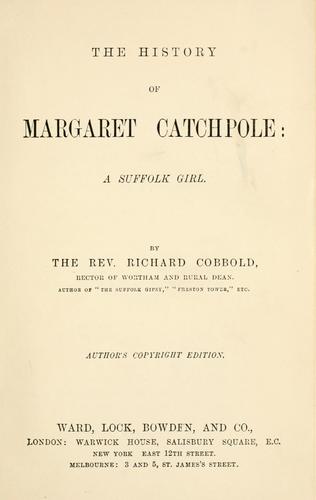
The History of Margaret Catchpole, a Suffolk GirlCobbold, Richard
General
The History of Margaret Catchpole, a Suffolk Girl
Cobbold, Richard
Catchpole, Margaret, 1762-1819 -- Fiction
It required both nerve and presence of mind, as well as bodily strength
to support herself in this position only for a few minutes. She
gradually drew the child nearer to her, and though in great danger
herself, her first words to him were, "Don't be afraid, Master Henry; I
have got you! Keep still! keep still! don't struggle!"
The gardener and the coachman had by this time arrived with the ladder
and a rope, they let it down from the arm of the tree, resting the upper
stave just against its branches. The gardener descended a few steps, and
Margaret gave him the child, whilst she herself remained with the boughs
in her hand, until the boy was safe. She then requested them to throw
her the rope, that she might leave go of the willow and be drawn to the
side of the pond. She put the rope round her waist and took hold of it,
doubled, with both hands, and in this way was dragged through the water
to the bank.
Thus was Margaret Catchpole, for the third time, the providential
instrument in preserving the life of a member of Mr. Cobbold's family.
It will not, then, be a matter of surprise, that the records of her life
should have been so strictly preserved among them. If there had been any
former coolness or misunderstanding between her and any of the domestics
of the family, this event completely reconciled all differences. It was
felt by one and all, that a woman who could risk her life to save
another's, in this manner, was worthy of their united respect. She was,
at this time, at the very summit of her reputation. A few days more
brought the news of that celebrated victory over the French fleet,
which added so much to the naval glory of Old England. In that victory
more than one Ipswich man partook, and returned to speak of the
engagement. One poor fellow, in particular, was sent home, desperately
wounded, who, for many years, became an object of respect, as well as
charitable attention, to many families in the town and neighbourhood.
This was poor old Jack, whose friends kept the Salutation public-house,
in Carr Street, who always went by the name of "What Cheer?" When he
first returned to his aunt, the landlady of the house, he had his senses
perfect, and could speak of the engagement with such clearness and
precision as delighted the seamen who frequented the house. He was on
board the same ship as Will Laud, and on the 1st of June they fought
side by side.
Public-domain text, read in full here on John Shaqi.
Reviews
Reviews
No reviews yet
Be the first to share your thoughts on this work.
Elsewhere in the archive
Join the Discussion
Join the discussion
Sign in to leave a comment or review.
Sign InorCreate an account