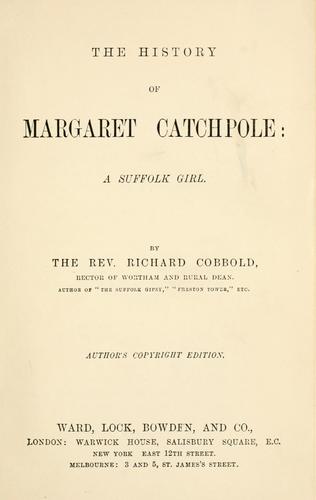
The History of Margaret Catchpole, a Suffolk GirlCobbold, Richard
General
The History of Margaret Catchpole, a Suffolk Girl
Cobbold, Richard
Catchpole, Margaret, 1762-1819 -- Fiction
Where the heart is unsettled, things seldom go on well. There wants that
peace and security which can alone make the discharge of our daily
duties a daily pleasure. Margaret's early impressions of religion had
been of a very desultory kind, and here was the root of all the evil
that afterwards befell her. The want of fixed religious principles early
instilled into the young mind has caused many a good disposition to
give way to those changes and chances which happen in life, and to
create an alteration even in the brightest prospects. In the earliest
days of this child of nature, an innate humanity of disposition had been
cultivated and increased by her attendance on a sick and afflicted
sister and an aged mother, both of whom had constantly required her aid.
Her natural qualities were, as the reader has seen, up to this moment of
the noblest cast. Still, in the absence of any strong religious
sentiment, the best dispositions are at the mercy of violent passions,
and are subject to the most dangerous caprices. The reader must have
observed that, in the midst of all her good qualities, Margaret
Catchpole evinced a pertinacity of attachment to the object of her
affections, even in his most unworthy days--an attachment which no
circumstances whatever, not even the warning of her sister's death-bed,
could shake. She had built upon a vague hope of Laud's alteration of
life, and his settlement in some quiet occupation. She had been
accustomed to very great disappointments and vexations; and, with a
spirit above her years, she had borne them all, and had shown an energy
of mind and activity worthy of better things. How weak are all qualities
without the support of religion! At a time when promises seemed most
fair, when an unexpected reconciliation had taken place with her uncle
and aunt Leader, when Laud's return was daily expected, and all the
favours of a generous family were heaped upon her for her good
conduct,--at such a time an alteration of her disposition took place,
which embittered her existence for many years. She became peevish and
irritable, discontented and unhappy, moody and melancholy. She thanked
nobody for assistance, asked nothing of any one, and gave no reason to
any of her fellow-servants for this sudden alteration. Such would not
have been the case, had religion taught her, as it now does many in her
station of life, how to feel supported in prosperity as well as in
adversity. It is a trite saying, that "we seldom know when we are well
off." We are not content to "let well alone;" but too often foolishly
speculate upon the future, and fall into some present snare.
Public-domain text, read in full here on John Shaqi.
Reviews
Reviews
No reviews yet
Be the first to share your thoughts on this work.
Elsewhere in the archive
Join the Discussion
Join the discussion
Sign in to leave a comment or review.
Sign InorCreate an account