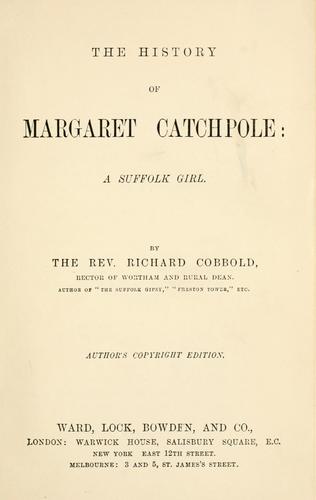
The History of Margaret Catchpole, a Suffolk GirlCobbold, Richard
General
The History of Margaret Catchpole, a Suffolk Girl
Cobbold, Richard
Catchpole, Margaret, 1762-1819 -- Fiction
He next visited Boyton and Sudbourn, and Orford. He lodged at the
Mariner's Compass, then kept by an old weather-beaten sailor, who often
put him across from the quay on the banks of the Alde, to the North
Vere; and here he used to spend so many hours, that the coastguard, who
kept a watch upon his movements, suspected that his countryman's dress
was only a ruse to hide some sinister intention. They observed, however,
that he did not avoid them, but rather sought opportunity for their
acquaintance. A more dreary place than this North Vere is scarcely to be
found on all the coast of Great Britain. It is a mass of shingle nearly
twenty miles long, in some places nearly a mile broad, in others, only a
few hundred yards. This wall of pebbles separates the river Alde from
the ocean. The bank reaches from Hollesley Bay to Aldeburgh. The sea and
the river are very deep along the shelving banks on either side.
Thousands upon thousands of sea-birds build, or rather lay their eggs,
upon this desolate bed of shingle. A few wild, straggling plants of
seakale, and very long, thin, sickly spires of grass, occasionally shoot
up through the stones; but there is no other vegetation, except here and
there in some few hollows in this desert of stones, where a little clay,
mixed with the sea-fowl dung, formed a green patch. These spots used to
be much frequented by smugglers, which, from their sunken situations,
used to hide both them and their goods from view. Nothing prominent can
be seen for miles round this coast, except the Orford lights, which
stand conspicuous enough about midway between Hollesley and Aldeburgh.
The poor fellows who acted as preventive-service men in the coastguard
had no sinecure in this dreadful situation. The sun burnt them by day,
and the wind, from whatever quarter it blew, and especially in the
winter nights, was cutting and cold; and from the exposure between two
waters, the sea and the river, it roared like the discharge of
batteries. In some of the hollows these poor men used to construct huts
of such rude materials as came to hand; old pieces of wrecks, or
broken-up boats, which they covered with seaweed, collected after a
storm. These served to break the east winds which blew over the German
Ocean, in their terrible night-watches, which they were forced to keep
pretty constantly, as they were watched, though they were watchers. Many
were the desperate struggles upon this wild beach between these brave
men and the smugglers, in which hard fighting, and too often
death-blows, told the desperate nature of the service.
"Well, my man, what brings you upon this coast?" said one of the
officers to Edward Catchpole, as he was sauntering lazily along the
seaside.
"Oh," replied Edward, "I have got a holiday, and I wish to spend a day
or two by the seaside."
Public-domain text, read in full here on John Shaqi.
Reviews
Reviews
No reviews yet
Be the first to share your thoughts on this work.
Elsewhere in the archive
Join the Discussion
Join the discussion
Sign in to leave a comment or review.
Sign InorCreate an account