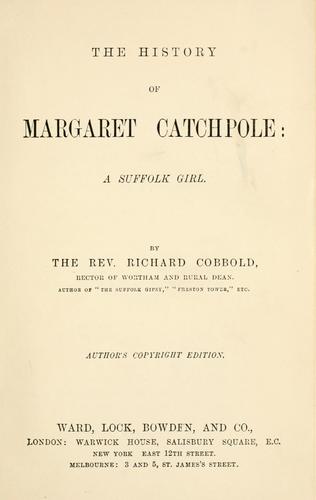
The History of Margaret Catchpole, a Suffolk GirlCobbold, Richard
General
The History of Margaret Catchpole, a Suffolk Girl
Cobbold, Richard
Catchpole, Margaret, 1762-1819 -- Fiction
Having implored and obtained forgiveness from her master and mistress,
Margaret became more composed, and made a full confession of her guilt.
She acknowledged that she had been persuaded, and even compelled, to
this act by a man named John Cook, a sailor at Ipswich, and declared
that she stole the horse by his direction and threats; that she was to
have sold it at Chelmsford, but that she dared not offer it there. She
did not once betray her lover's name, or mention anything about his
hiding-place; but she described all the particulars of the robbery with
which the reader is acquainted, and stated, as a corroborative fact,
that her own clothes would be found, if not already removed, under the
manger of the empty stall.
Her deposition having been then read over to her by the clerk, she
signed her name to it. Before they parted, Mrs. Cobbold spoke to her
consolingly, while she placed before her mind the heinousness of her
offence. Poor Margaret felt better after this, and with a heart very
much humbled, was committed to Newgate by N. Bond, Esq., with an order
for her removal as soon as the forms could be gone through, to the gaol
of the county in which the offence was committed. Mr. Cobbold was bound
over to prosecute, which being done, that gentleman and his lady
returned to their hotel.
Every effort was made to discover the resort of John Cook; but that
scamp, the moment he heard of the capture, decamped, nor was he ever
after heard of. He was well known; and the landlord of the Marquis
Cornwallis testified to Margaret's having been at his house with the
man, as also his being at the same place with Captain Laud, as he was
called, the evening before. But what became of him no one ever knew. The
half of a letter from his companion in London was found at the inn, and
was adduced to show his connexion with a gang of horse-stealers; but
this only served to tell against poor Margaret on her trial.
Margaret was removed to Ipswich by _habeas corpus_, July 6th, 1797, and
Mr. Ripshaw, the gaoler, informed her mistress of her arrival.
On the evening of the day Margaret arrived at Ipswich, she wrote the
following letter to her mistress. It has been already stated that she
had been taught to read and write, and keep accounts, by Mrs. Cobbold,
when she superintended the education of her family; and the results of
this teaching, as exemplified in the touching epistles which we shall
hereafter present to the reader, will doubtless be received with
singular interest, copied as they are from the original documents, which
are carefully preserved in the family. The following is the first she
ever wrote:--
"Ipswich, Thursday, July 6th, 1797.
"HONOURED MADAM,
Public-domain text, read in full here on John Shaqi.
Reviews
Reviews
No reviews yet
Be the first to share your thoughts on this work.
Elsewhere in the archive
Join the Discussion
Join the discussion
Sign in to leave a comment or review.
Sign InorCreate an account