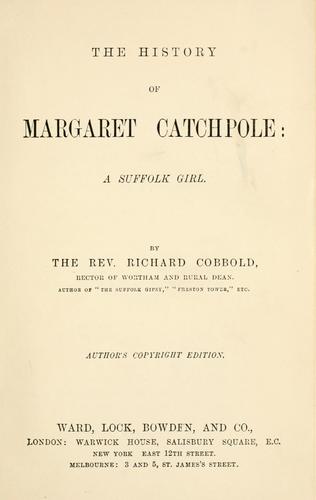
The History of Margaret Catchpole, a Suffolk GirlCobbold, Richard
General
The History of Margaret Catchpole, a Suffolk Girl
Cobbold, Richard
Catchpole, Margaret, 1762-1819 -- Fiction
"Are there any persons present," said the judge, "who are ready to speak
to the previous character of the prisoner?" Whereupon the prosecutor,
her master, immediately ascended the witness-box. He stated that the
prisoner had, during the time she lived in his service, always
discharged her duty faithfully. He had reason to believe that she was
neither a hardened nor an abandoned character. He knew from experience
that she was most humane and faithful, and ready to risk her own life in
the service of another. He here mentioned her presence of mind, and the
intrepidity she had so signally displayed in saving the lives of his
children. He stated, moreover, that, for his own part, he never should
have prosecuted the prisoner but that the magistrates in London had
bound him over so to do, and a sense of duty compelled him to adopt this
course. He should always entertain, under all circumstances, a grateful
recollection of her. He particularly recommended her to mercy, because
he did not believe that she had committed the crime in question in
conjunction with any gang of horse-stealers, but that she was the dupe
of an infamous villain, who had persuaded her to steal the horse for
him, and for no pecuniary benefit to herself. He believed her to be a
proper object for royal clemency, and hoped that if his lordship could
find any mitigating circumstances in her favour, that he would give her
the full benefit of them.
George Stebbing, Esq., surgeon, Ipswich, stated that he had known the
prisoner from her childhood; that in her earliest years she gave promise
of such good character and conduct as would have merited the approbation
of all men. He mentioned her riding the pony to Ipswich.
Margaret put her head down upon the bar, and, hiding her face in her
hands, sobbed audibly before the whole court.
The doctor stated that, if she was at that moment at liberty, he would
take her into his own house. He assured his lordship that it was a
romantic hope of seeing her lover, that induced her to listen to the
voice of the tempter who induced her to steal the horse. He prayed for
mercy for her, and handed a petition to the court, signed by many
persons who knew her early history, and bore testimony to her former
good character.
Her uncle and aunt Leader next spoke in the highest terms of her general
good character. Her first mistress at the Priory Farm gave her also an
excellent character for honesty and humanity, and assured his lordship
that it was an early but unfortunate attachment which had been the cause
of this rash act; adding, that neither she nor her husband would object
to take the prisoner again into their service.
Several other persons spoke in her favour, and so cordial and so earnest
had been the testimony borne to her character, that in almost every
breast a hope began to prevail that mercy would be extended to her.
Public-domain text, read in full here on John Shaqi.
Reviews
Reviews
No reviews yet
Be the first to share your thoughts on this work.
Elsewhere in the archive
Join the Discussion
Join the discussion
Sign in to leave a comment or review.
Sign InorCreate an account