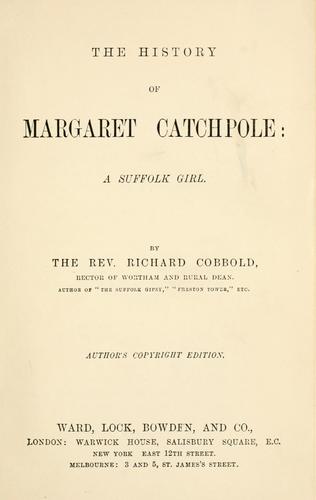
The History of Margaret Catchpole, a Suffolk GirlCobbold, Richard
General
The History of Margaret Catchpole, a Suffolk Girl
Cobbold, Richard
Catchpole, Margaret, 1762-1819 -- Fiction
But where was William Laud? At his old trade. He was deeply concerned in
that affair at Dunwich, where William Woodward and Benjamin Lawsey, two
boatmen belonging to his majesty's Customs at Southwold, were beaten and
thrown into the sea; and the government offered one hundred pounds
reward for the apprehension of any one of the offenders. Forty empty
carts were seen by these two men, standing ready for a run, with horses
and men in a lane at Dunwich. The reward was offered in the county
newspapers of the date of March 2nd, 1799.
Such a system of open fraud was carried on along the whole coast of
Norfolk and Suffolk about this time, that the revenue of the kingdom
began to suffer severely in the customs. In the month of March of the
second year of her imprisonment, Mr. Gooch, officer of excise at
Lowestoft, and Mr. Burdell, of Aldborough, seized 880 gallons of gin,
belonging to Will Laud and his company; and the evidence brought the
affair so clearly home to him that he was taken up and sentenced to be
imprisoned one year in the Ipswich gaol, and to pay a fine of one
hundred pounds to the king. His property was seized and confiscated;
smuggled goods were found upon his premises, and he became a penniless
bankrupt, and an inmate of that very prison where the devoted Margaret
was suffering on his account.
FOOTNOTES:
[Footnote 10: All traces of Edward Catchpole having been lost, the
author is obliged to Henry T. Bourne, Esq., of Alford, in Lincolnshire,
for making known to him, since the publication of the work, the
circumstances which are here briefly narrated.
Edward Catchpole went into Lincolnshire, and resided some time at
Sutton-in-the-Marsh. He was always fond of the sea, and for some years
became mate of the _Argus_ revenue cutter. In this vessel, he was
present at the rescue of an English coal brig, from the _Star_, French
privateer; and having put men on board the brig, sufficient to carry her
into port, he pursued the privateer, brought her to close quarters, and
having only twenty-seven men on board the cutter, he was overpowered,
and at ten o'clock at night compelled to surrender, as the privateer had
eighty-six men against him.
This was on the 18th September, 1807. He was made prisoner, and having
spent seven years in confinement, he made his escape, and reached home
in safety.
He was afterwards appointed chief officer of the coastguard, at
Sutton-in-the-Marsh, in the county of Lincoln. Though a very brave man,
and a steady officer, he did not appear to have any very serious notions
of religion, until he was compelled by a serious wound to keep at home.
It was the blessing of God to him, and others, that this accident
happened to him, for his mind appears to have been awakened to a deep
sense of his past sins, and his soul very much aroused to inquiry, by
the kindness of an excellent neighbour, who dressed his wounds for him,
and did her best endeavours to pour in consolation upon his broken
heart.
Public-domain text, read in full here on John Shaqi.
Reviews
Reviews
No reviews yet
Be the first to share your thoughts on this work.
Elsewhere in the archive
Join the Discussion
Join the discussion
Sign in to leave a comment or review.
Sign InorCreate an account