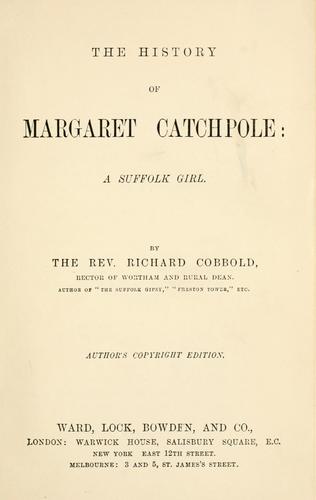
The History of Margaret Catchpole, a Suffolk GirlCobbold, Richard
General
The History of Margaret Catchpole, a Suffolk Girl
Cobbold, Richard
Catchpole, Margaret, 1762-1819 -- Fiction
and cast her, with considerable force and clatter upon the stone-flag
pavement.
The noise of the fall brought out the governor and the turnkey at the
same moment, who, both concluding that the weight had overpowered her,
ran to her assistance, whilst the sailor, well knowing he could be of no
use, walked quietly away. No one in the gaol knew that he was Margaret's
lover. She was carried into the governor's house. The turnkey said he
had often removed the horses, considering they were too heavy for a
female to lift, though they were frequently carried by them. Margaret
told Mr. Ripshaw that the over-exertion had for a moment produced a
dizziness in her head, and a sudden faintness came upon her before she
fell. She dreaded, however, lest any one should imagine the real cause
of her accident. Her friend, the surgeon of the gaol, Mr. George
Stebbing, was sent for; and when he saw her he bled her, considering
that she had received some internal injury. It was a good thing he did
so, for it reduced her to such real weakness as confined her some days
to her bed, and afforded time for reflection.
Mrs. Ripshaw had promised Mrs. Cobbold, that if Margaret should be ill
at any time she would let her know it, and she now fulfilled that
promise. She sent her a note to tell her how the accident occurred, and
how she was. Mrs. Cobbold came immediately, and found her in an
unaccountable state of agitation. She at once asked Margaret if
anything particular had occurred, but she elicited nothing satisfactory.
No one in the gaol except Margaret knew Will Laud, and no one took any
particular notice of him but her. A letter, which was afterwards found
upon his person, shows how truly that poor girl had loved so unworthy a
man. Opportunities of occasional words were at different times offered
and seized upon by them, though these were few and far between. By
these, however, Margaret learned that he was a ruined man, sentenced to
a year's imprisonment, and to pay a fine of one hundred pounds to the
king; that in all probability his confinement might be for years, as
everything he possessed had been confiscated; his boats, ships, and
stock, had been seized; and yet imprisonment was to continue till the
penalty was paid.
The letter which Margaret wrote to him about this period, and contrived
to give into his hands, showed how deeply she entered into his past as
well as present feelings, and is a noble specimen of her devoted
affection:--
"FELONS' CELL, Jan. 10th, 1800.
"DEAR WILLIAM,
Public-domain text, read in full here on John Shaqi.
Reviews
Reviews
No reviews yet
Be the first to share your thoughts on this work.
Elsewhere in the archive
Join the Discussion
Join the discussion
Sign in to leave a comment or review.
Sign InorCreate an account