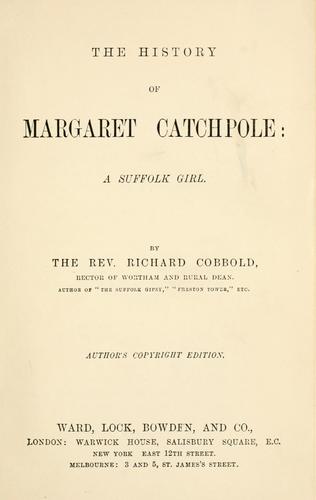
The History of Margaret Catchpole, a Suffolk GirlCobbold, Richard
General
The History of Margaret Catchpole, a Suffolk Girl
Cobbold, Richard
Catchpole, Margaret, 1762-1819 -- Fiction
Meantime, Laud, directly he left the gaol, went to his sister's house at
Sudbourn. He reached that place the same night. He told his sister who
it was that had paid the fine for him, and thus completely won her heart
for Margaret. His plan was fixed to get off with Margaret in a
smuggler's boat, and get a cast to Holland, where he intended to marry
and settle. He told his sister his plan, and she approved it, and
promised to receive Margaret.
He was not long in ascertaining what boats were expected on the coast.
He had an interview with one David Shaw, the master of a cutter
belonging to Captain Merrells, and with him came to an understanding
that, some day after the 25th, when wind and weather should suit, he
should send a boat ashore for him. A red handkerchief tied round his hat
should be the signal that he was ready. He told him that he should be
accompanied by a friend, whom he wished to go over the water with him.
All these things were arranged, and, as far as they went, were in some
sense honourable. In the meantime he promised to assist in landing any
cargoes along the shore. And this part of the contract he performed.
On the 19th of March, Mr. Ripshaw, with seven prisoners, departed for
Bury. The business of the assizes began on Thursday, the 20th, and did
not terminate until that day week, the 27th. On Monday and Tuesday the
wash took place. On these occasions the female convicts are all locked
up in one large room, from seven o'clock in the morning until seven in
the evening; their food being brought to them in the washing-room. At
seven in the evening they all go into the felons' yard for exercise and
air. They usually give their signal that the wash is finished by rapping
the door about seven o'clock. This evening, Tuesday, the 25th, Margaret
contrived by various means to prolong the wash till nearly eight
o'clock, and as she had some kind of acknowledged authority and
influence among her fellow-convicts, she insisted upon the signal not
being given till the work was completely finished; so that at eight
o'clock it was quite dark. They were let out of the room into the
felons' yard at that time for one half hour. Some were accustomed to
saunter about, or to have a game of romps. Some, when the season
admitted, would weed the flower-beds; for Mr. Ripshaw was a great fancy
florist, and used to raise the best ranunculuses, carnations, and
polyanthuses, of any person in the town. His garden adjoined the felons'
walk, and was only separated from it by a very low paling. Margaret had
continual access to the garden, and used to take considerable interest
in the culture of the plants.
She was greatly disappointed to find that all the linen-horses stood on
the stone area, between the debtors' and felons' yards. She had hoped
that they would have been carried by the turnkey to the drying ground in
the garden, as usual, ready for the linen in the morning. Owing to some
cause or other, they were not there that night.
Public-domain text, read in full here on John Shaqi.
Reviews
Reviews
No reviews yet
Be the first to share your thoughts on this work.
Elsewhere in the archive
Join the Discussion
Join the discussion
Sign in to leave a comment or review.
Sign InorCreate an account