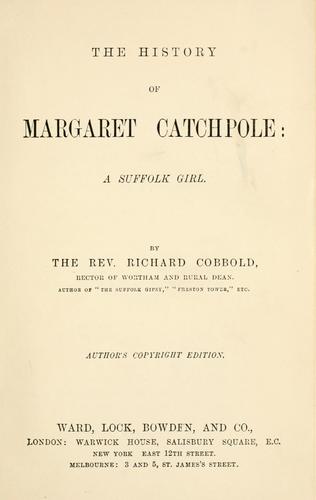
The History of Margaret Catchpole, a Suffolk GirlCobbold, Richard
General
The History of Margaret Catchpole, a Suffolk Girl
Cobbold, Richard
Catchpole, Margaret, 1762-1819 -- Fiction
She put her lips to the wall of the cell where she was, and answered,
"Yes." It sounded exactly as if she was in bed in her own cell; and to
her great joy she heard the key turn in the iron lock, and the bolt
shoot into its place. She breathed for a moment freely, but the next
moment she experienced such a sudden revulsion as few could have borne
without detection. To her confusion and dismay, the turnkey entered the
very cell where she lay concealed under the bed. He walked up to the
iron-grated window, and, as usual, the casement stood open for the
benefit of air through the passage, and, in a soliloquizing manner,
said, "Ah! poor Sarah! you will never sleep upon this bed again!"
In breathless agony did Margaret dread two things equally fatal to her
project. One was, that he should hear her breath in the stillness of the
night, and discover her; the other, that he should lock the door upon
her. She knew that it was not usual to lock the doors of those cells
which contained no prisoners, but she dreaded lest the same absence of
mind which made him saunter into Sarah Lloyd's cell should make him look
the door. What a state of suspense! How did her blood course through her
frame! she could hear her heart beat! She was presently relieved from
her suspense, for the turnkey, having completed his duty in locking up
all his prisoners, quietly departed out of the cell, and left the door,
as usual, standing wide open. Never was relief more opportune or welcome
than this to her overcharged heart. The clock struck the hours of nine,
ten, and eleven, and Margaret had not stirred. She now rose, took her
shoes in her hand, and her bundle under her arm; she then managed to tie
it up with an apron-string over her shoulders, and, with the slightest
tread, stole along the stone passage. A mouse would scarcely have been
disturbed by her as she descended the front of steps that led to the
felons' yard.
To her great comfort she found the door unbolted; for the turnkey,
having locked every one up, saw no necessity for bolting the yard door.
Silently she opened it; it creaked so little, that the wind prevented
any sound reaching beyond the precincts of the door. She made her way to
the flower-stand in the governor's garden, lifted the frame out of the
ground and set it up endways directly under the broken spike. It reached
a little more than half way up the wall, being about thirteen feet long.
She then went and took the linen line off the posts, and made a running
noose at one end of it. She then took the longest clothes-prop she could
find, and passed the noose over the horn of it. She mounted the frame by
the help of the prop, and standing upon it she lifted the line up and
passed the noose over the shoulder of the _chevaux de frise_, then,
pulling it tight and close to the wall, it slipped down the iron and
became fixed.
Public-domain text, read in full here on John Shaqi.
Reviews
Reviews
No reviews yet
Be the first to share your thoughts on this work.
Elsewhere in the archive
Join the Discussion
Join the discussion
Sign in to leave a comment or review.
Sign InorCreate an account