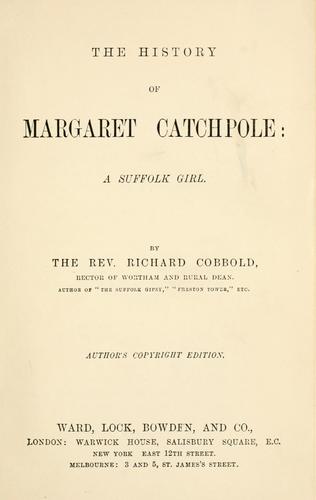
The History of Margaret Catchpole, a Suffolk GirlCobbold, Richard
General
The History of Margaret Catchpole, a Suffolk Girl
Cobbold, Richard
Catchpole, Margaret, 1762-1819 -- Fiction
The morning after Margaret's escape the turnkey was alarmed by the call
of the gardener, who came early to the prison to prune some trees in the
governor's garden. He told the turnkey there was a rope hanging down the
wall, as if some one had escaped during the night. They soon discovered
the frame against the wall; footmarks along the beds, and the linen
crotch, all told the same tale. The turnkey then ran to the men's cells,
and found them all bolted. He did the same to the women's, and found
them likewise fastened just as he left them the night before. He then
examined every window. Not a bar was moved. He did this without speaking
a word to any one. At the usual hour he called up the prisoners, and
marched them out of their cells. Margaret's was the last, at the end of
the passage. When he opened it, no one answered his summons. He walked
in; no one was there. The bed had not been slept in, and was without
sheets. He then made Mrs. Ripshaw acquainted with the facts.
Astonishment and alarm were depicted upon her countenance. Her husband's
absence made the circumstance the more distressing.
Search was made in every part of the gaol, but no trace of Margaret
could be found. The women with whom she washed the day previously all
declared that they knew nothing of her escape. They declared that they
saw her go before them to the farther end of the passage to her own
cell. But how could she escape and lock the door? The turnkey was quite
sure he had secured her in her own cell, for that he went into the one
adjoining after he had, as he supposed, locked her up in hers. It came
out, however, in the course of inquiry, that he remembered her asking
him about the horses not being set out for the wash; and the women
declared that Margaret had been very peremptory about not giving the
signal before eight o'clock. These things seemed to indicate a design to
escape, and carried some suspicion of the fact.
Mrs. Ripshaw, however, was not satisfied, but sent a swift messenger on
horseback to Bury St. Edmunds, with a note to acquaint her husband with
the circumstances. Mrs. Ripshaw also wrote to Mrs. Cobbold in the
greatest agitation, begging of her, if she knew where she was, to give
information of it, as her husband and two sureties were bound, under a
penalty of five hundred pounds each, to answer for the escape of any
prisoner from the gaol. Such a stir was created in the town of Ipswich
by this event as was scarcely ever before witnessed. People flocked to
the gaol to see the spot whence Peggy had made her escape, and many were
the reports falsely circulated concerning her.
It is not easy to describe the grief and consternation which was truly
felt by Margaret's dearest and best friend. She knew the consequences of
this rash act; that, if she was taken, it was death, without any hope of
reprieve.
Public-domain text, read in full here on John Shaqi.
Reviews
Reviews
No reviews yet
Be the first to share your thoughts on this work.
Elsewhere in the archive
Join the Discussion
Join the discussion
Sign in to leave a comment or review.
Sign InorCreate an account