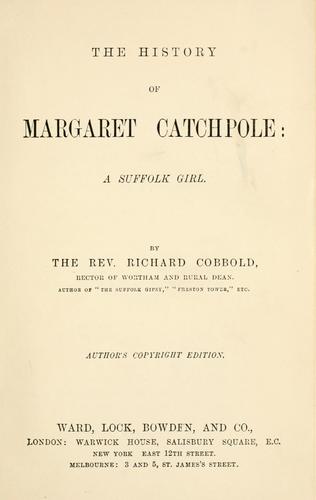
The History of Margaret Catchpole, a Suffolk GirlCobbold, Richard
General
The History of Margaret Catchpole, a Suffolk Girl
Cobbold, Richard
Catchpole, Margaret, 1762-1819 -- Fiction
"You have done a noble deed, and one which will immortalize your name,
one which will form a source of happy reflection to you hereafter, most
noble man of war! You have killed a harmless man, and have taken captive
a poor fugitive female! Happy warrior! you will be nobly rewarded!"
"Do not reproach me, Margaret, but forgive me. I have only done my duty;
and, however painful it has been, you would not reproach me, if you did
but know how much I really grieved for you."
"Your grief for me will do me about as much good as mine will poor
William!" and here Margaret burst into a flood of tears, which words
could not in any way repress.
A post-chaise was ordered to the inn-door, and Margaret, apparently more
dead than alive, was placed within it, and the gaoler taking his seat
beside her, they were conveyed immediately to Ipswich.
She was once more confined within those walls which she had so recently
scaled; she made no secret of the manner in which she had effected her
escape; she fully confessed her own work, and perfectly exonerated every
other person in the gaol.
It was well for the poor turnkey that she was captured. He was
immediately released from confinement, and reinstated in his office.
Margaret was now kept in almost solitary confinement, to mourn over her
unhappy lot, and to reflect upon the death of one whom she had loved too
well.
CHAPTER XXVII
SECOND TRIAL, AND SECOND TIME CONDEMNED TO DEATH
After the arrival of Margaret at the Ipswich gaol, several magistrates
attended, at the request of Mr. Ripshaw, to take the deposition of the
prisoner. She was summoned into the gaoler's parlour, or, as it was more
properly called, the "Magistrates' Room." The depositions of Mr. Ripshaw
and of the constable of Sudbourn, were first taken down. The nature of
the offence was then for the first time explained to Margaret, and its
most dreadful consequences at once exposed. She was taken completely by
surprise. She had no idea that, in doing as she had done, she had been
guilty of anything worthy of death, and made no hesitation in telling
the magistrates so. She told them, moreover, that her conscience did not
accuse her of any crime in the attempt, and that she thought it a cruel
and bloody law which could condemn her to death for such an act.
"But are you aware," said Mr. Gibson, one of the visiting magistrates,
"that you have broken that confidence with Mr. Ripshaw which he placed
in you, and that you subjected him and his sureties to the penalty of
five hundred pounds each, had he not recovered you, and brought you back
to prison?"
Public-domain text, read in full here on John Shaqi.
Reviews
Reviews
No reviews yet
Be the first to share your thoughts on this work.
Elsewhere in the archive
Join the Discussion
Join the discussion
Sign in to leave a comment or review.
Sign InorCreate an account