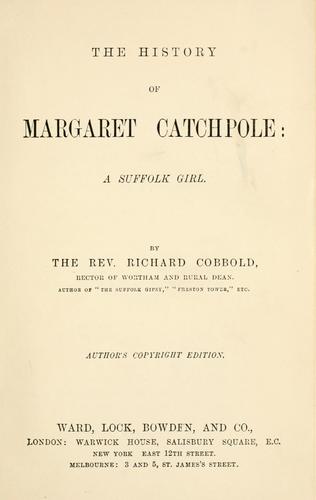
The History of Margaret Catchpole, a Suffolk GirlCobbold, Richard
General
The History of Margaret Catchpole, a Suffolk Girl
Cobbold, Richard
Catchpole, Margaret, 1762-1819 -- Fiction
"'Any prisoner breaking out of gaol, if he resist his gaoler, may be
killed on the spot, in the attempt of the gaoler to restrain him. And
any person breaking out after sentence of death, shall be considered
liable to that punishment for his original offence, which had been
commuted, and shall suffer death accordingly. If he escape through the
door of his prison, when left open, it shall not be felony, because it
is the negligence of the gaoler; but if he break out, after proper
caution exercised for his security, either by force in the day, or by
subtlety in the night, then it shall be felony.'
"Such is the law; and though in your case, young woman, you may not
consider it just, yet when you reflect upon your example to others, you
will see it in a different light. If every prisoner should go unpunished
who broke out of prison what continual attempts would be made to escape!
I am truly sorry for your case; but the law is made for offenders; and
it is our duty to send you to Bury again for trial. In the meantime, the
gaoler will be upon the alert, and take good care that you do not commit
the same offence again."
Margaret thanked Mr. Gibson for his explanation. She felt very sorry,
she said, if she had offended any one, and hoped they would forgive her
ignorance and unintentional offence.
She was fully committed to take her trial for the second offence. Mr.
Gibson was much astonished at her presence of mind and singularly acute
understanding, as well as appropriate and becoming form of speech, which
she used as naturally as she felt it. His words to one deeply interested
for Margaret were, "What a pity that such a woman should not know the
value of her liberty before she lost it!"
The reader knows the reason why Margaret broke out of prison, and has
seen how she became a second time amenable to the laws. He will observe,
that it was from her acquaintance with that desperate man, who had been
the cause of misery to her and her family, from the first days of her
acquaintance with him. But he was now dead. The cause was removed, and
with it died every wish of her heart for life and liberty.
But it was not the place that made Margaret so unhappy. It was the void
occasioned by the having no one now to love, that made her feel as if no
one in the world loved her. In this she was greatly mistaken; for though
her offence had occasioned much condemnation among those who were
interested in her, yet they were not so lost to pity and compassion as
not to feel for her sufferings. Among the foremost of those friends was
her former mistress, who, in the true sense of the word, was charitable.
Public-domain text, read in full here on John Shaqi.
Reviews
Reviews
No reviews yet
Be the first to share your thoughts on this work.
Elsewhere in the archive
Join the Discussion
Join the discussion
Sign in to leave a comment or review.
Sign InorCreate an account