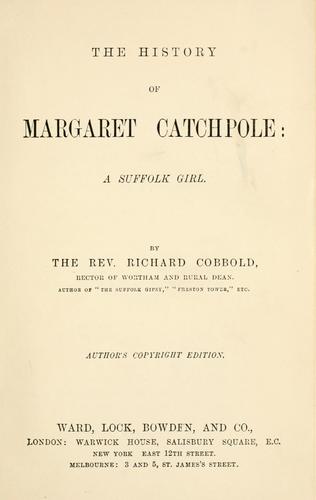
The History of Margaret Catchpole, a Suffolk GirlCobbold, Richard
General
The History of Margaret Catchpole, a Suffolk Girl
Cobbold, Richard
Catchpole, Margaret, 1762-1819 -- Fiction
"Margaret, I came to see you from a sense of duty to God, and to you
too: I came to try and comfort you; but how can I give consolation to
you if you talk of your being ill-fated and _doomed_ to despair? Do not
say that the doom of fate has anything to do with your present
situation. You know as well as I do, that unless you had misconducted
yourself, you might have been as happy now as you were when I saw you
after your return from Bury. Put your sin upon yourself, and not upon
your fate. You know the real cause of this unhappiness."
"Ah! dear lady, what would you have done if you had been me and in my
place?"
"I might have done as you did; but I do think, Margaret, knowing what a
friend I had always been to you, that you might have placed confidence
in me, and have told me Laud was in prison. I observed that you were
much disturbed, and not yourself, when I last came to see you, but I
could not divine the cause."
"I was afraid to tell you, madam, lest you should persuade me to give up
my acquaintance with him, and I had learned much more to his credit than
I knew before."
"And so, by following your own inclination, you have brought your lover
and yourself to an untimely death. Oh, Margaret! had you confided in me,
I should have persuaded you to have tried him until you had obtained
your discharge from prison; then, had he been a respectable and altered
man, I should have approved of your marriage."
"But think, dear lady, how constant he had been to me for so many years!
Surely his patience deserved my confidence."
"And what good did you ever find it do you, Margaret? Look at the
consequences."
"I could not foresee them. How could I then look at them?"
"Though you were so blind as not to foresee the consequences, others,
with more reflection and forethought, might have done so for you; and,
assuredly, had you hinted the matter to me, I should have prevented
what has happened."
"I wish indeed, now, that I had done so. I suffer most severely in my
mind, not from the fear of punishment, but because I have been the cause
of William Laud's death."
"And he will have been the cause of your own, Margaret. Had he not
persuaded you to break out of prison, he would not have been killed. He
knew the penalty was death to you if you were caught, and he has met
that very end to which he has now made you liable. Had he loved you
lawfully and honourably, as he ought to have done, he would have waited
for your free and happy discharge."
"But it seems to me," said Margaret, "so very strange, something so out
of justice, to condemn a person to die for that which does not appear to
her to be a crime. I cannot see the blood-guiltiness that I have thus
brought upon myself. In God's commandments I find it written, 'Thou
shalt not steal.' I stole the horse, and I could see that I deserved to
die, because I transgressed that commandment; but I do not find it said,
'Thou shalt not escape from prison.'"
Public-domain text, read in full here on John Shaqi.
Reviews
Reviews
No reviews yet
Be the first to share your thoughts on this work.
Elsewhere in the archive
Join the Discussion
Join the discussion
Sign in to leave a comment or review.
Sign InorCreate an account