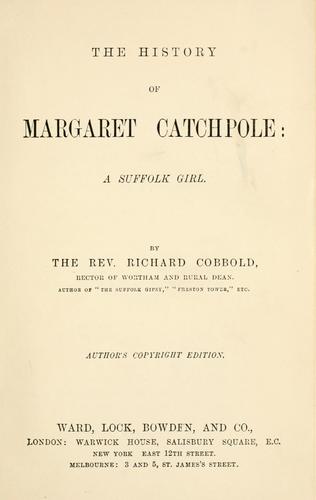
The History of Margaret Catchpole, a Suffolk GirlCobbold, Richard
General
The History of Margaret Catchpole, a Suffolk Girl
Cobbold, Richard
Catchpole, Margaret, 1762-1819 -- Fiction
"If a prisoner who knows himself to be guilty does not prepare
himself to die before the sentence of death is passed upon him, his
is a very dangerous state, since the period is so short between
condemnation and execution that he must be very much distracted."
"You have read through 'The Christian's Consolations against the
Fears of Death,' and you tell me that your mind has been greatly
strengthened by the piety expressed in this good old book. I agree
with you that it touches upon every source of consolation which a
Christian man can contemplate. It meets almost every case. But it
does not exactly contemplate a female convict, like yourself; and
on this account I would add a very few words of advice to you upon
this subject.
"To die a Christian, and as a Christian ought to die, is to have no
desire whatever but for the kingdom of God. You suffer justly for
your crimes; and you must not let any one deceive you into any
false idea of your own worthiness to live. The penitent malefactor
on the tree rebuked the boldness of his brother, who railed upon
the Saviour of the world, and used these words of reproof, 'Dost
not thou fear God, seeing thou art in the same condemnation? And we
indeed suffer justly; but this man hath done nothing amiss.' Then
he prefers that humble prayer, which should ever be yours,
Margaret, up to your latest moment, 'Lord, remember me when thou
comest into Thy kingdom!' How infinite in mercy is the Lord! How
loving! How pitiful! How generous to the poor wretch at the moment
of his late repentance! We cannot tell, Margaret, how late that
repentance was. He might have been convinced of his guilt long
before he was lifted up to die. In prison he might have heard, as
you have done, of the great, the good, the only Christ. So that men
do wrong to take even this example for the success of a death-bed
repentance at the last hour. We cannot tell when our last hour may
be. Our first should be one of repentance as well as our last. And
the whole desire of our lives should be, to be remembered in the
kingdom of Christ. The blessed words of our Saviour must have taken
away the sting of death from the faithful heart of the penitent:
'This day shalt thou be with Me in Paradise.'
Public-domain text, read in full here on John Shaqi.
Reviews
Reviews
No reviews yet
Be the first to share your thoughts on this work.
Elsewhere in the archive
Join the Discussion
Join the discussion
Sign in to leave a comment or review.
Sign InorCreate an account