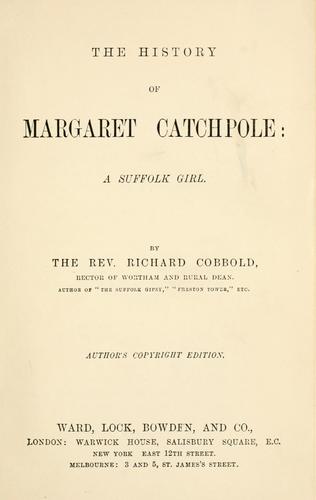
The History of Margaret Catchpole, a Suffolk GirlCobbold, Richard
General
The History of Margaret Catchpole, a Suffolk Girl
Cobbold, Richard
Catchpole, Margaret, 1762-1819 -- Fiction
The tears started in more eyes than her own, as she spoke, in her
touching simplicity, of these acute feelings. She suffered intensely;
and it took many months of rational and devout conversation, on the part
of both her mistress and this worthy man, to eradicate those bitter
seeds of despair, and to sow those of cheerfulness and hope. After
directing Margaret's mind to Christian duties, the chaplain and the
judge left her cell. They conversed some time upon her state of mind and
future prospects. The judge declared that he thought her one of the most
sensitive persons he had ever seen, with a mind capable of the highest
cultivation. He left five guineas with the chaplain to be laid out for
her benefit. He stated that she would not, in all probability, leave
England till the next summer, and hoped to hear a better account of her
some future day. Margaret was not informed of the person who had visited
her that day with the chaplain, until she had learned to look upon him
and herself in a very different light.
The Lord Chief Baron visited all the cells of the prison, and expressed
his approbation of the cleanliness and neatness of the whole place. As
he was going away, he told the turnkey that he was the very judge who
had tried the female prisoner for breaking out of gaol. The reader may
imagine how frightened the poor fellow was at his late boldness of
speech. The judge observed his embarrassment, and told him that he had
spoken nothing improper; that he had done his duty, and deserved his
thanks.
"You may tell your master," he added, "that I am so well satisfied with
the appearance of all things under his care, that when I return to town
I shall not fail to give a favourable report of the state of the gaol
and of his discipline." He made the turnkey a present, and left the
gaol.
It was not until May, 1801, that Margaret Catchpole was informed of the
day of her departure for Botany Bay. She had been instructed in many
things relating to the country to which she was going, and her kind
mistress had purchased an assortment of useful articles for her future
employment. Her mind had been gradually divested of its miserable
horrors, and became fortified for the occasion. It will be seen,
however, that as the near approach of the day came, she dreaded and
lamented it bitterly. On the 25th of May, 1801, Mrs. Cobbold received
the following note from her:--
"IPSWICH GAOL, May 25th, 1801.
"DEAR AND HONOURED MADAM,
Public-domain text, read in full here on John Shaqi.
Reviews
Reviews
No reviews yet
Be the first to share your thoughts on this work.
Elsewhere in the archive
Join the Discussion
Join the discussion
Sign in to leave a comment or review.
Sign InorCreate an account