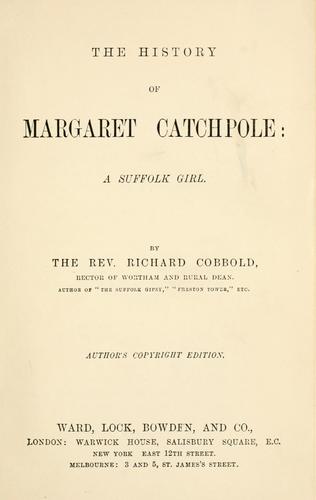
The History of Margaret Catchpole, a Suffolk GirlCobbold, Richard
General
The History of Margaret Catchpole, a Suffolk Girl
Cobbold, Richard
Catchpole, Margaret, 1762-1819 -- Fiction
"One favour more, sir: your blessing."
"May God bless you, Margaret," said the good chaplain, "and make you,
for the remainder of your days, an instrument of good, to His own glory
and the benefit of your fellow-creatures! Amen. Farewell."
On Wednesday, May 27, Mr. Ripshaw left Ipswich with three female
prisoners in his charge, Margaret Catchpole, Elizabeth Killet, and
Elizabeth Barker. He took them to Portsmouth, and saw them safe on board
the convict-ship, bound for Botany Bay.
Margaret had not left the New Gaol, two hours before the turnkey was
summoned to the lodge, and opened the door to a tall, thin man, dressed
in the poorest garb, who with a voice soft and gentle, meek and
melancholy, requested to see Margaret Catchpole.
"She is just departed with the governor for Portsmouth. Who are you?"
"I am her brother. My misfortunes are indeed heavy: I am just returned
from India. I find my father gone, my brothers gone, and this my only
sister, worse than all! Oh, bitter cup! gone in disgrace from the
country!"
"Pray walk this way. I will introduce you to our chaplain, and some
consolation may be found for you."
The melancholy truth was soon explained. Charles Catchpole, alias Jacob
Dedham, alias Collins Jaun, the spy, whom the reader may recognize as
mentioned in a former part of this history, returned to his native
country literally a beggar. He went out to India, and, upon his arrival
in that country, his friend, Lord Cornwallis, had resigned his high
office, and returned to England. The account he gave of himself was
singularly eventful. He assumed the appearance of a native chief, joined
some of the roving tribes of warlike adventurers, and became a
conspicuous character. He fell in love with a nabob's daughter, and
married her according to the national customs and ceremonies; but his
ill-assorted match did not long prosper. His origin and connexion with
the English were discovered, and the spy had to fly the country for his
life. He escaped, gained his passage home, and had spent his last
shilling in the very public-house at St. Mary Elms where he received his
first as an enlisted recruit. His case was that day mentioned to several
individuals, amongst others to Edward Bacon, Esq., who had spent many
years in India, who pronounced him no impostor. He employed him many
days in taking a view of Ipswich and its environs, which he did with
extraordinary accuracy, from Savage's windmill on Stoke Hills. This view
was presented by that gentleman to the author of these pages, and it
presents all the striking accuracy and patient persevering
characteristics of a self-taught artist.
By his own industry, and the generosity of others, he gained a few
pounds, with which he determined to settle in one of the colonies. He
obtained a passage to the Cape of Good Hope; but the poor fellow met
with a severe accident in falling down the hold of the vessel, broke his
back, and died upon the passage.
* * * * *
Public-domain text, read in full here on John Shaqi.
Reviews
Reviews
No reviews yet
Be the first to share your thoughts on this work.
Elsewhere in the archive
Join the Discussion
Join the discussion
Sign in to leave a comment or review.
Sign InorCreate an account