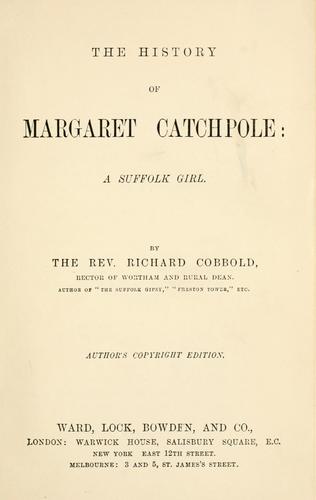
The History of Margaret Catchpole, a Suffolk GirlCobbold, Richard
General
The History of Margaret Catchpole, a Suffolk Girl
Cobbold, Richard
Catchpole, Margaret, 1762-1819 -- Fiction
"I am sorry to say that Barker has to spin for government, her
character not being such as to deserve a good report: she is still
upon the stores. But she can get her stint of work done by one
o'clock if she chooses to work hard at it, and then her time is her
own till six. Pray, sir, give my kind remembrance to all my
fellow-prisoners, and tell any of them that may be sentenced to
come out to this country not to be dead-hearted, as I was, about
Botany Bay; for if they are sent out, and will only conduct
themselves well, they will be better off than in prison.
"The greater part of this country is not yet explored; and if
inhabited, it is by natives of a very low caste and hideous
features. Those that I have already seen are of a very ferocious
aspect. They carry along with them spears of great length, made of
hard wood, and a sort of hatchet, made of bone, stone, or very hard
wood. They look half-starved, and have very long, lank visages,
most hideously distorted by various customs; such as knocking out a
front tooth to denote their arrival at manhood, painting their
brows, and putting quills through the cartilage which separates the
nostrils of their wide-distended noses.
"Their females, I am told, are in a very degraded condition, and
are generally stolen from other tribes, and brutally treated, being
beaten into immediate subjection by their husbands, who steal them.
The men seem to me a very subtle race. If they meet an unarmed
white man at a distance from home, they will spear and rob him.
They behave themselves well enough when they come into the town,
and visit, as they do sometimes, the Female Orphan Asylum, where I
live. If they did not they would soon be punished; still they are
very sly and treacherous, and can take up things with their long
toes as easily as we do the same with our hands.
"They often have a grand fight among themselves, either to gratify
their leader or to settle some dispute between the tribes. Twenty
or thirty join in the fight, whilst all the others look on, as if
it was only a game of play; but some of them are sure to be killed.
There is nothing said or done to them for killing each other in
this manner. What horrible barbarians they must be!
Public-domain text, read in full here on John Shaqi.
Reviews
Reviews
No reviews yet
Be the first to share your thoughts on this work.
Elsewhere in the archive
Join the Discussion
Join the discussion
Sign in to leave a comment or review.
Sign InorCreate an account