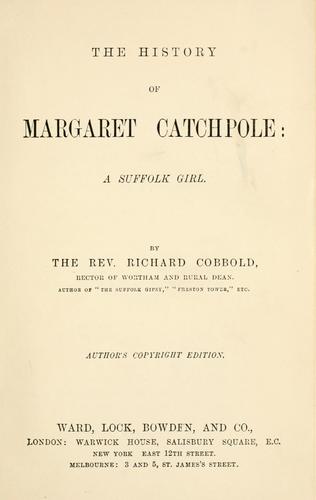
The History of Margaret Catchpole, a Suffolk GirlCobbold, Richard
General
The History of Margaret Catchpole, a Suffolk Girl
Cobbold, Richard
Catchpole, Margaret, 1762-1819 -- Fiction
"I have left Mrs. Palmer's service for a time, at her own
particular request, and am now living as housekeeper to a young
friend of hers, who married her niece. He is a free settler. His
wife was a very sickly lady, and had, since she resided in this
spot, fallen into a rapid decline; indeed she was in a poor state
of health during her sea-voyage. She was a good and amiable lady,
and her loss is a great misfortune to the young man, and much
sorrow to my dear Mrs. Palmer.
"The free settlers are the great farmers of this country; they have
one hundred acres of land as a grant, with power to purchase as
many more as they can; they have to clear away the woods, and burn
up the stumps, before they can grow corn, though the swine thrive
well in the thick bush. We begin to set wheat in March or April,
and the harvest comes on in November; and as soon as that is
cleared off, they set fire to the stubble, and burn it on the land,
and then put in fresh corn directly. They do not plough it, but
dibble the corn in without cleaning it, as the burning straw
destroys the roots of all the weeds.
"In clearing new land, it is broken up by men with very large hoes,
and it is the hardest work that is done in the country. A great
price is paid for this labour, and men work too hard at it. They
frequently destroy their health and their lives, by their
over-exertion to get rich enough to buy farms for themselves. This
has been done by some robust men, but others fall a prey to the
toil.
"This is a very dangerous country at present to settle in. The
natives, who are almost black, wear no covering, but go, most of
them, in a state of nudity. They paint their bodies with a
light-coloured ochre, marking out the ribs and bones so strongly,
that at a little distance in the shade they look like so many
moving skeletons. They are a most miserable, half-starved race of
men, but very active, very treacherous, and very bold. They seem to
have no shame. They used to bear a deadly hatred to the white
people; and if all I hear be true of some of the dealings of our
colonists with these poor wretches, I am not surprised at it.
"They are much more reconciled to us than they were, and actually
send some of their young children to be instructed in our schools.
I do not think, however, that the race will ever amalgamate with
our own, it appears such an inferior and unsettled one. As we
advance our settlers towards the Blue Mountains, these people will
recede from us, and being divided into many tribes hostile to each
other, will never be able to unite their forces against us.
Public-domain text, read in full here on John Shaqi.
Reviews
Reviews
No reviews yet
Be the first to share your thoughts on this work.
Elsewhere in the archive
Join the Discussion
Join the discussion
Sign in to leave a comment or review.
Sign InorCreate an account