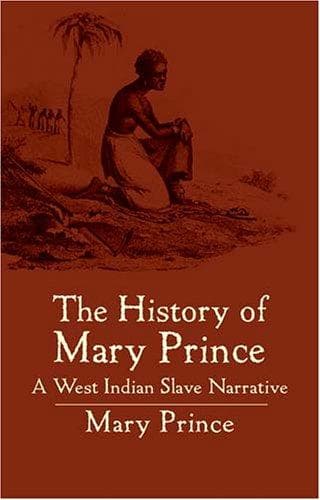
The History of Mary Prince, a West Indian SlavePrince, Mary
History
The History of Mary Prince, a West Indian Slave
Prince, Mary
Fugitive slaves -- West Indies -- Biography; Prince, Mary; Slavery -- West Indies
In conclusion, I may observe that the history of Mary Prince furnishes a
corollary to Lord Stowell's decision in the case of the slave Grace, and
that it is most valuable on this account. Whatever opinions may be held by
some readers on the grave question of immediately abolishing Colonial
Slavery, nothing assuredly can be more repugnant to the feelings of
Englishmen than that the system should be permitted to extend its baneful
influence to this country. Yet such is the case, when the slave landed in
England still only possesses that qualified degree of freedom, that a
change of domicile will determine it. Though born a British subject, and
resident within the shores of England, he is cut off from his dearest
natural rights by the sad alternative of regaining them at the expence of
liberty, and the certainty of severe treatment. It is true that he has the
option of returning; but it is a cruel mockery to call it a voluntary
choice, when upon his return depend his means of subsistence and his
re-union with all that makes life valuable. Here he has tasted "the sweets
of freedom," to quote the words of the unfortunate Mary Prince; but if he
desires to restore himself to his family, or to escape from suffering and
destitution, and the other evils of a climate uncongenial to his
constitution and habits, he must abandon the enjoyment of his
late-acquired liberty, and again subject himself to the arbitrary power of
a vindictive master.
The case of Mary Prince is by no means a singular one; many of the same
kind are daily occurring: and even if the case were singular, it would
still loudly call for the interference of the legislature. In instances of
this kind no injury can possibly be done to the owner by confirming to the
slave his resumption of his natural rights. It is the master's spontaneous
act to bring him to this country; he knows when he brings him that he
divests himself of his property; and it is, in fact, a minor species of
slave trading, when he has thus enfranchised his slave, to _re-capture_
that slave by the necessities of his condition, or by working upon the
better feelings of his heart. Abstractedly from all legal technicalities,
there is no real difference between thus compelling the return of the
enfranchised negro, and trepanning a free native of England by delusive
hopes into perpetual slavery. The most ingenious casuist could not point
out any essential distinction between the two cases. Our boasted liberty
is the dream of imagination, and no longer the characteristic of our
country, if its bulwarks can thus be thrown down by colonial special
pleading. It would well become the character of the present Government to
introduce a Bill into the Legislature making perpetual that freedom which
the slave has acquired by his passage here, and thus to declare, in the
most ample sense of the words, (what indeed we had long fondly believed to
be the fact, though it now appears that we have been mistaken,) THAT
Public-domain text, read in full here on John Shaqi.
Reviews
Reviews
No reviews yet
Be the first to share your thoughts on this work.
Elsewhere in the archive
Join the Discussion
Join the discussion
Sign in to leave a comment or review.
Sign InorCreate an account