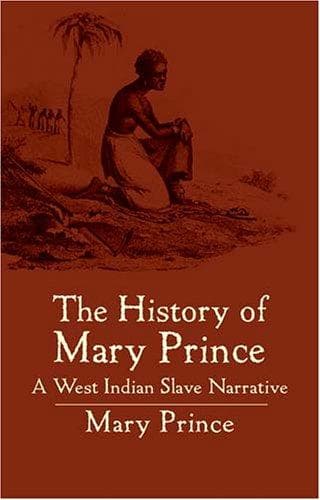
The History of Mary Prince, a West Indian SlavePrince, Mary
History
The History of Mary Prince, a West Indian Slave
Prince, Mary
Fugitive slaves -- West Indies -- Biography; Prince, Mary; Slavery -- West Indies
We lament to add, that the Pearl which brought these negroes to our shore,
was restored to its owners at the instance of the French Government,
instead of being condemned as a prize to Lieut. Rye, who, on his own
responsibility, detained her, with all her manacles and chains and other
detestable proofs of her piratical occupation on board. We trust it is not
yet too late to demand investigation into the reasons for restoring her.
_The Negro Boy's Narrative._
My father's name was Clashoquin; mine is Asa-Asa. He lived in a country
called Bycla, near Egie, a large town. Egie is as large as Brighton; it
was some way from the sea. I had five brothers and sisters. We all lived
together with my father and mother; he kept a horse, and was respectable,
but not one of the great men. My uncle was one of the great men at Egie:
he could make men come and work for him: his name was Otou. He had a great
deal of land and cattle. My father sometimes worked on his own land, and
used to make charcoal. I was too little to work; my eldest brother used to
work on the land; and we were all very happy.
A great many people, whom we called Adinyes, set fire to Egie in the
morning before daybreak; there were some thousands of them. They killed a
great many, and burnt all their houses. They staid two days, and then
carried away all the people whom they did not kill.
They came again every now and then for a month, as long as they could find
people to carry away. They used to tie them by the feet, except when they
were taking them off, and then they let them loose; but if they offered to
run away, they would shoot them. I lost a great many friends and relations
at Egie; about a dozen. They sold all they carried away, to be slaves. I
know this because I afterwards saw them as slaves on the other side of the
sea. They took away brothers, and sisters, and husbands, and wives; they
did not care about this. They were sold for cloth or gunpowder, sometimes
for salt or guns; sometimes they got four or five guns for a man: they
were English guns, made like my master's that I clean for his shooting.
The Adinyes burnt a great many places besides Egie. They burnt all the
country wherever they found villages; they used to shoot men, women, and
children, if they ran away.
Public-domain text, read in full here on John Shaqi.
Reviews
Reviews
No reviews yet
Be the first to share your thoughts on this work.
Elsewhere in the archive
Join the Discussion
Join the discussion
Sign in to leave a comment or review.
Sign InorCreate an account