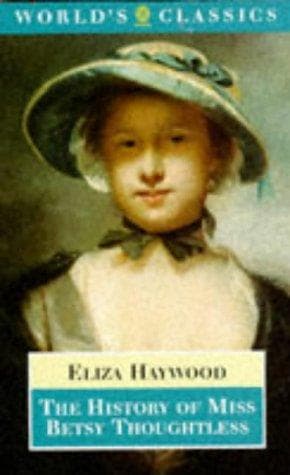
The History of Miss Betsy ThoughtlessHaywood, Eliza Fowler
General
The History of Miss Betsy Thoughtless
Haywood, Eliza Fowler
Abused wives -- Fiction; Bildungsromans; Didactic fiction; England -- Fiction; Married women -- Fiction
He was then shewed into the back-parlour, which was the room where Mr.
Goodman generally received those persons who came to him upon business.
On hearing who it was that asked for him, he was a little surprized, and
desired he would walk up stairs: but Mr. Staple not knowing but there
might be company above, returned for answer, that he had no more than a
word or two to say to him, and that must be in private; on which the
other immediately came down to him.
This young lover having by accident been informed, not only that Mr.
Trueworth made his addresses to Miss Betsy, but also that it was with
him she had been engaged during all that time he had been deprived of
seeing her, thought it proper to talk with Mr. Goodman concerning this
new obstacle to his wishes. That worthy gentleman was extremely troubled
to be questioned on an affair, on which he had given Miss Betsy his word
not to interfere: but finding himself very much pressed by a person
whose passion he had encouraged, and who was the son of one with whom he
had lived in a long friendship, he frankly confessed to him that Mr.
Trueworth was indeed recommended to Miss Betsy by her brother; told him
he was sorry the thing had happened so, but had nothing farther to do
with it; that the young lady was at her own disposal, as to the article
of marriage; that he was ignorant how she would determine; and that it
must be from herself alone he could learn what it was he might expect
or hope.
Mr. Staple received little satisfaction from what Mr. Goodman had said;
but resolved to take his advice, and, if possible, bring Miss Betsy to
some eclaircissement of the fate he was to hope or fear. Accordingly, he
came the next morning to visit her; a liberty he had never taken, nor
would now, if he had not despaired of finding her in the afternoon.
She gave herself, however, no airs of resentment on that account: but
when he began to testify his discontent concerning Mr. Trueworth, and
the apprehensions he had of his having gained the preference in her
heart, though the last who had solicited that happiness, she replied, in
the most haughty tones, that she was surprized at the freedom he took
with her; that she was, and ever would be, mistress of her actions and
sentiments, and no man had a right to pry into either; and concluded
with saying, that she was sorry the civilities she had treated him with,
should make him imagine he had a privilege of finding fault with those
she shewed to others.
It is not to be doubted but that he made use of all the arguments in his
power to convince her, that a true and perfect passion was never
unaccompanied with jealous fears. He acknowledged the merits of Mr.
Trueworth: 'But,' added he, 'the more he is possessed of, the more
dangerous he is to my hopes.' And then begged her to consider the
torments he had suffered, while being so long deprived of her presence,
and knowing, at the same time, a rival was blessed with it.
Public-domain text, read in full here on John Shaqi.
Reviews
Reviews
No reviews yet
Be the first to share your thoughts on this work.
Elsewhere in the archive
Join the Discussion
Join the discussion
Sign in to leave a comment or review.
Sign InorCreate an account