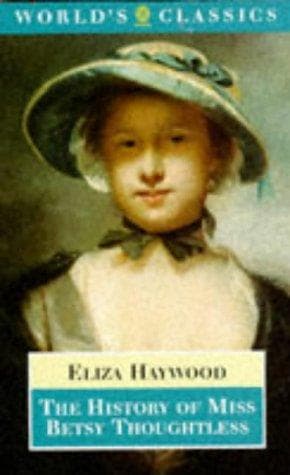
The History of Miss Betsy ThoughtlessHaywood, Eliza Fowler
General
The History of Miss Betsy Thoughtless
Haywood, Eliza Fowler
Abused wives -- Fiction; Bildungsromans; Didactic fiction; England -- Fiction; Married women -- Fiction
Though Mr. Goodman had as yet no intimations of the accidents of that
morning, yet was he extremely uneasy; the looks, as well as words of Mr.
Staple, in going of his house the day before, were continually in his
mind, and he could not forbear apprehending some fatal consequence
would, one time or another, attend the levity of Miss Betsy's behaviour
and conduct, in regard to her admirers: he was also both surprized and
vexed, that Mr. Bloomacre, from whom he expected an explanation of the
Westminster Abbey adventure, had not come according to his request. This
last motive of his disquiet was, however, soon removed: Mr. Bloomacre,
who was no less impatient to clear himself of all blame concerning the
transactions of that night, had no sooner finished his affair with Lord
----, and was dismissed by the high-bailiff, than he came directly to
Mr. Goodman's, and recited to him, and all the ladies, the whole of what
had passed.
Miss Betsy laughed prodigiously; but Mr. Goodman shook his head, on
hearing the particulars related by Mr. Bloomacre; and, after that
gentleman was gone, reproved, as he thought it his duty to do, the
inconsiderateness of her conduct: he told her, that as she was alone,
she ought to have left the Abbey as soon as divine service was ended;
that, for a person of her sex, age, and appearance, to walk in a place
where there were always a great concourse of young sparks, who came for
no other purpose than to make remarks upon the ladies, could not but be
looked on as very odd by all who saw her. 'There was no rain,' said he,
'till a long time after the service was ended, and you might then, in
all probability, have got a chair; or if not, the walk over the Park
could not have been a very great fatigue.'
Miss Betsy blushed extremely, not through a conscious shame of imagining
what she had done deserved the least rebuke, but because her spirit, yet
unbroke, could not bear control: she replied, that as she meant no ill,
those who censured her were most in fault. 'That is very true,' answered
Mr. Goodman; 'but, my dear child, you cannot but know it is a fault
which too many in the world are guilty of. I doubt not of your
innocence, but would have you consider, that reputation is also of some
value; that the honour of a young maid, like you, is a flower of so
tender and delicate a nature, that the least breath of scandal withers
and destroys it. In fine, that it is not enough to be good, without
behaving in such a manner as to make others acknowledge us to be so.'
Public-domain text, read in full here on John Shaqi.
Reviews
Reviews
No reviews yet
Be the first to share your thoughts on this work.
Elsewhere in the archive
Join the Discussion
Join the discussion
Sign in to leave a comment or review.
Sign InorCreate an account