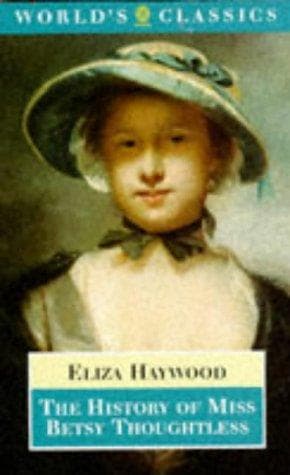
The History of Miss Betsy ThoughtlessHaywood, Eliza Fowler
General
The History of Miss Betsy Thoughtless
Haywood, Eliza Fowler
Abused wives -- Fiction; Bildungsromans; Didactic fiction; England -- Fiction; Married women -- Fiction
On her first coming to town, a woman had been recommended to her for
starching, and making up her fine linen. This person she had ever since
employed, and took a great fancy to, as she found her honest,
industrious, and very obliging. The poor creature was unhappily married;
her husband was gone from her, and had listed himself for a soldier.
Being born in a distant country, she had no relations to whom she could
apply for assistance; was big with child, and had no support but the
labour of her hands. These calamitous circumstances so much touched the
commiserative nature of Miss Betsy, that she frequently gave her double
the sum she demanded for her work, besides bestowing on her many things
she left off wearing; which, though trifles in themselves, were very
helpful to a person in such distress.
Miss Mabel, for whom she also worked at the same time, was no less her
patroness than Miss Betsy. In fine, they were both extremely kind to
her; insomuch as made her often cry out, in a transport of gratitude,
that these two good young ladies were worth to her all the customers
she had besides. They continued to prove themselves so indeed; for when
her child was born, which happened to be a girl, they stood godmothers;
and not only gave handsomely themselves, but raised a contribution among
their acquaintance, for the support of the lying-in woman and her
infant: the former, however, did not long enjoy the blessing of two such
worthy friends; she died before the expiration of her month; and the
latter, being wholly destitute, was about to be thrown upon the parish.
Some well-disposed neighbour, who knew how kind Miss Mabel and Miss
Betsy had been, came and acquainted them with the melancholy story: they
consulted together; and each reflecting that she had undertaken the
protection of this infant at the font, thought herself bound by duty to
preserve if from those hardships with which children thus exposed are
sometimes treated; they, therefore, as they were equally engaged, agreed
to join equally in the maintenance of this innocent forlorn.
This was a rare charity indeed! and few there are, especially at their
years, who so justly consider the obligations of a baptismal covenant.
It was also the more to be admired, as neither of them had the incomes
of their fortunes in their own hands, the one being under guardianship,
and the other at the allowance of a father, who, though rich, was
extremely avaricious.
Public-domain text, read in full here on John Shaqi.
Reviews
Reviews
No reviews yet
Be the first to share your thoughts on this work.
Elsewhere in the archive
Join the Discussion
Join the discussion
Sign in to leave a comment or review.
Sign InorCreate an account