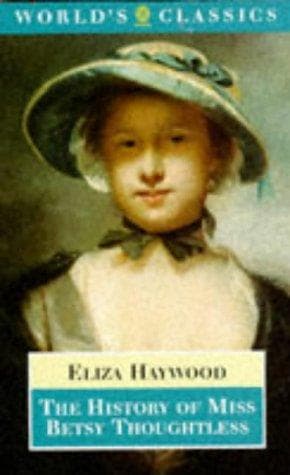
The History of Miss Betsy ThoughtlessHaywood, Eliza Fowler
General
The History of Miss Betsy Thoughtless
Haywood, Eliza Fowler
Abused wives -- Fiction; Bildungsromans; Didactic fiction; England -- Fiction; Married women -- Fiction
He began with asking her how it happened, that he had not seen Mr.
Trueworth for so long a time: to which she replied, with the utmost
indifference, that she took some things ill from that gentleman, and
that, perhaps, he might have some subject of complaint against her;
'Therefore,' said she, 'as our humours did not very well agree, it was
best to break off conversation.'
He then questioned her concerning Mr. Munden. 'I hope,' said he, 'you
have taken care to inform yourself as to his character and
circumstances.'--'No, truly, Sir,' answered she, with the same careless
air as before; 'as I never intend to be the better or the worse for
either, I give myself no pain about what he is.' Mr. Goodman shook his
head; and was going to reason with her on the ill consequences of such
a behaviour, when some company coming in, broke off, for a time, all
farther discourse between them.
CHAPTER XX
_Shews Miss Betsy left entirely to her own management, and the cause of
it, with some other particulars_
Mr. Goodman, who had been a little vexed at being interrupted in the
remonstrances he thought so highly necessary should be made to Miss
Betsy, took an opportunity of renewing them the next morning, in the
strongest expressions he was master of.
Miss Betsy, with all her wit, had little to say for herself in answer to
the serious harangue made to her by Mr. Goodman on her present fashion
of behaviour; her heart avowed the justice of his reproofs, but her
humour, too tenacious of what pleased itself, and too impatient of
control, would not suffer her to obey the dictates either of his or her
own reason. She knew very well the tender regard he had for her, on the
account of her deceased father, and that all he spoke was calculated for
her good; but then it was a good she was not at present ambitious of
attaining, and thought it the privilege of youth to do whatever it
listed, provided the rules of virtue were unfringed; so that all he
could get from her was--that her amusements were innocent--that she
meant no harm in any thing she did--that it was dull for her to sit at
home alone; and, when in company, could not quit it abruptly on any
consideration of hours.
Public-domain text, read in full here on John Shaqi.
Reviews
Reviews
No reviews yet
Be the first to share your thoughts on this work.
Elsewhere in the archive
Join the Discussion
Join the discussion
Sign in to leave a comment or review.
Sign InorCreate an account