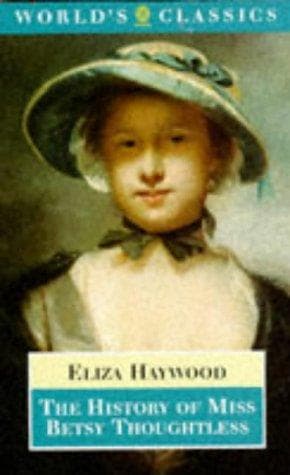
The History of Miss Betsy ThoughtlessHaywood, Eliza Fowler
General
The History of Miss Betsy Thoughtless
Haywood, Eliza Fowler
Abused wives -- Fiction; Bildungsromans; Didactic fiction; England -- Fiction; Married women -- Fiction
Mr. Trueworth, as the reader may have observed, did not all at once
withdraw his affections from the first object of them, nor transmit them
to the second but on very justifiable motives. The levity of Miss Betsy,
and other branches of ill conduct, had very much weaned her from his
heart before the wicked artifices of Miss Flora had rendered her quite
contemptible in his opinion, and had not wholly devoted himself to the
beauties of Miss Harriot, till he was quite convinced the perfections of
her mind were such as could not fail of securing the conquest which her
eyes had gained.
He did not however presently declare himself; he saw the friendship
between the two sisters would be somewhat of an obstacle to his hopes;
he had heard that Miss Harriot had rejected several advantageous
proposals of marriage, merely because she would not be separated from
Mrs. Wellair; he also found, that Sir Bazil, though for what reason he
could not guess, seemed not very desirous of having his sister disposed
of: the only probable way, therefore, he thought, of obtaining his
wishes, was to conceal them till he found the means of insinuating
himself so far into the good graces both of the one and the other, as to
prevent them from opposing whatever endeavours he should make to engage
their sister to listen to his suit.
The strategem had all the effect for which it was put in practice: the
intimacy he had long contracted with Sir Bazil now grew into so perfect
a friendship, that he scarce suffered a day to pass without an
invitation to his house. Mrs. Wellair expressed the highest esteem and
liking of his conversation; and Miss Harriot herself, not imagining of
what consequence every word that fell from her was to him, said a
thousand obliging things on his account; particularly, one day, after
they had been singing a two-part song together, 'How often,' cried she
to her sister, 'shall we wish for this gentleman, when we get into the
country, to act the principal part in our little operas!'
All this he returned in no other manner than any man would have done who
had no farther aim than to shew his wit and gallantry: so much of his
happiness, indeed, depended upon the event, that it behoved him to be
very cautious how he proceeded; and it is likely he would not have
ventured to throw off the mask of indifference so soon as he did, if he
had not been emboldened to it by an unexpected accident.
Public-domain text, read in full here on John Shaqi.
Reviews
Reviews
No reviews yet
Be the first to share your thoughts on this work.
Elsewhere in the archive
Join the Discussion
Join the discussion
Sign in to leave a comment or review.
Sign InorCreate an account