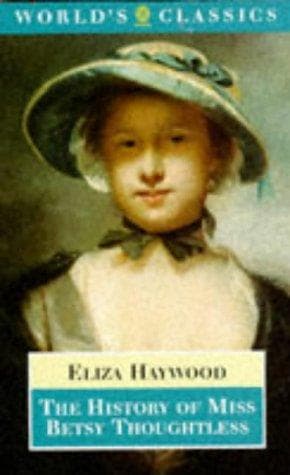
The History of Miss Betsy ThoughtlessHaywood, Eliza Fowler
General
The History of Miss Betsy Thoughtless
Haywood, Eliza Fowler
Abused wives -- Fiction; Bildungsromans; Didactic fiction; England -- Fiction; Married women -- Fiction
At night, on going to bed, she renewed the discourse; and pursued the
theme she had begun with such success, that she brought Miss Harriot to
confess she believed there was no man more deserving to be loved than
Mr. Trueworth. 'But, my dear sister,' said she, 'I have no inclination
to marry, nor to leave you: I am quite happy as I am, and desire to be
no more so.' To which the other replied, that was childish talking; that
she would, doubtless, marry some time or other; that she might, perhaps,
never have so good an offer, and could not possibly have a better;
therefore advised her not to slip the present opportunity; but, whenever
Mr. Trueworth should make a declaration of his passion to herself, to
receive it in such a manner as should not give him any room to imagine
she was utterly averse to his pretensions.
Miss Harriot suffered her to ruge her on this point for a considerable
time; but at last replied, in a low and hesitating voice, that she would
be guided by her friends, who, she was perfectly convinced, had her
interest at heart, and knew much better than herself what conduct she
ought to observe. To which Mrs. Wellair replied, that she doubted not
but the end would abundantly justify the advice that had been given
her.
The first thing this lady did in the morning, was to go to her brother's
chamber, and acquaint him with all that had passed between herself and
Miss Harriot; after which they agreed together, that Mr. Trueworth
should have an opportunity that very day of making his addresses to her.
Though Sir Bazil thought it needless to add any thing to what was
already done, yet he could not forbear taking an occasion, when they
were at breakfast, to mention Mr. Trueworth's name, and the many good
qualities he was possessed of. Mrs. Wellair joined in the praises her
brother gave him; but Miss Harriot spoke not a word: on which, 'Are you
not of our opinion, sister?' cried he to her. 'Yes, brother,' answered
she; 'Mr. Trueworth is certainly a very fine gentleman.'--'How cold is
such an expression,' resumed Sir Bazil, 'and even that extorted!'--'You
would not, sure, Sir,' said she, a little gaily, 'have me in raptures
about him, and speak as if I were in love with him?'
'Indeed, but I would!' cried Sir Bazil; 'and, what is more, would also
have you be so: he deserves it from you; and, as you must some time or
other be sensible of the tender passion, you cannot do it at more
suitable years.'--'I see no necessity,' replied she, 'for my being so at
any years.'
'It is a sign, then,' said he, 'that you have not consulted nature. Have
you never read what Lord Lansdown has wrote upon this subject? If you
have not, I will repeat it to you--
"In vain from Fate we strive to fly;
For, first or last, as all must die,
So, 'tis decreed by those above,
That, first or last, we all must love."'
Public-domain text, read in full here on John Shaqi.
Reviews
Reviews
No reviews yet
Be the first to share your thoughts on this work.
Elsewhere in the archive
Join the Discussion
Join the discussion
Sign in to leave a comment or review.
Sign InorCreate an account