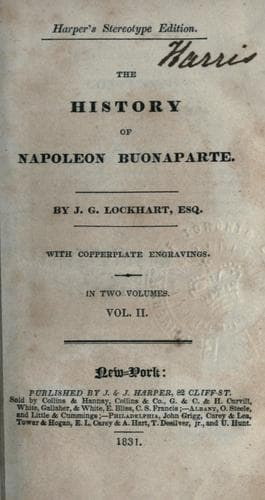
The History of Napoleon BuonaparteLockhart, J. G. (John Gibson)
History
The History of Napoleon Buonaparte
Lockhart, J. G. (John Gibson)
France -- Kings and rulers -- Biography; Napoleon I, Emperor of the French, 1769-1821
The three Directors, meanwhile, who were not in the secret, and who had
been much amused with seeing their colleague Sieyes set off on horseback
an hour or two earlier from the Luxembourg, had begun to understand
what that timely exhibition of the Abbé's awkward horsemanship
portended. One of them, Moulins, proposed to send a battalion to
surround Buonaparte's house and arrest him. Their own guard laughed at
them. Buonaparte was already in the Tuileries, with many troops around
him; and the Directorial Guard, being summoned by one of his
aides-de-camp, instantly marched thither also, leaving the Luxembourg at
his mercy. Barras sent his secretary to expostulate. Napoleon received
him with haughtiness. "What have you done," cried he, "for that fair
France which I left you so prosperous? For peace I find war; for the
wealth of Italy, taxation and misery. Where are the 100,000 brave French
whom I knew--where are the companions of my glory?--They are dead."
Barras, who well knew that Buonaparte would never forgive him for having
boasted that the conqueror of Italy and Egypt owed everything to his
early favour, and whose infamous personal conduct in the articles of
bribery and exaction made him tremble at the thought of impeachment,
resigned his office: so did his colleagues, Gohier and Moulins. Sieyes
and Ducos had done so already. Bernadotte, indeed, repaired to the
Luxembourg ere Moulins and Gohier had resigned, and offered his sword
and influence, provided they would nominate him to the command of the
forces jointly with Napoleon. They hesitated: his word of honour given
to Buonaparte, that he would do nothing _as a citizen_, rendered it
indispensable that they should take that decisive step; by doing so they
would at least have given the soldiery a fair choice--they
hesitated--and their power was at an end. The Luxembourg was immediately
guarded by troops in whom Napoleon could place implicit confidence. The
Directory was no more.
Barras, in his letter, said that "he had undertaken his office solely
for the purpose of serving the cause of liberty, _and_ that now, seeing
the destinies of the Republic in the hands of her young and invincible
general, he gladly resigned it." By this courtly acquiescence he
purchased indemnity for the past, and the liberty of retiring to his
country-seat, there to enjoy the vast fortune he had so scandalously
accumulated. The other two remained for the present under surveillance.
Public-domain text, read in full here on John Shaqi.
Reviews
Reviews
No reviews yet
Be the first to share your thoughts on this work.
Elsewhere in the archive
Join the Discussion
Join the discussion
Sign in to leave a comment or review.
Sign InorCreate an account