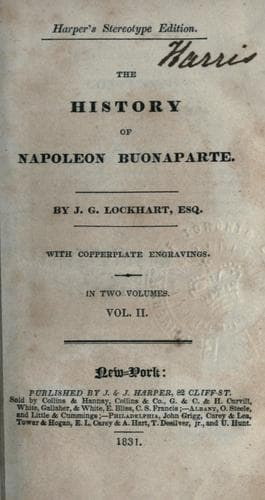
The History of Napoleon BuonaparteLockhart, J. G. (John Gibson)
History
The History of Napoleon Buonaparte
Lockhart, J. G. (John Gibson)
France -- Kings and rulers -- Biography; Napoleon I, Emperor of the French, 1769-1821
A far different scene was passing in the hostile assembly of the Five
Hundred. When its members at length found their way into the Orangery,
the apartment allotted for them, a tumultuous clamour arose on every
side. _Live the Constitution! The Constitution or death! Down with the
Dictator!_--such were the ominous cries. Lucien Buonaparte, the
president, in vain attempted to restore order: the _moderate_ orators of
the council, with equal ill success, endeavoured to gain a hearing. A
_democrat_ member at length obtained a moment's silence, and proposed
that the council should renew, man by man, the oath of fidelity to the
Constitution of the year _three_. This was assented to, and a vain
ceremony, for it was no more, occupied time which might have been turned
to far different account. Overpowered, however, by the clamour, the best
friends of Napoleon, even his brother Lucien, took the oath. The
resignatory letter of Barras was then handed in, and received with a
shout of scorn. The moment was come; Napoleon, himself, accompanied by
four grenadiers, walked into the chamber--the doors remained open, and
plumes and swords were visible in dense array behind him. His grenadiers
halted near the door, and he advanced alone towards the centre of the
gallery. Then arose a fierce outcry--_Drawn swords in the sanctuary of
the laws! Outlawry! Outlawry! Let him be proclaimed a traitor! Was it
for this you gained so many victories?_ Many members rushed upon the
intruder, and, if we may place confidence in his own tale, a Corsican
deputy, by name, Arena, aimed a dagger at his throat. At all events
there was such an appearance of personal danger as fired the grenadiers
behind him. They rushed forwards, and extricated him almost breathless;
and one of their number (Thomé) was at least rewarded on the score of
his having received a wound meant for the General.
It seems to be admitted that at this moment the iron nerves of
Buonaparte were, for once, shaken. With the dangers of the field he was
familiar--in order to depict the perfect coolness of his demeanour
during the greater part of this very day, his secretary says--"_he was
as calm as at the opening of a great battle_;" but he had not been
prepared for the manifestations of this civil rage. He came out,
staggering and stammering, among the soldiery, and said, "I offered them
victory and fame, and they have answered me with daggers."
Sieyes, an experienced observer of such scenes, was still on horseback
in the court, and quickly re-assured him. General Augereau came up but a
moment afterwards, and said, "You have brought yourself into a pretty
situation." "Augereau," answered Napoleon (once more himself again),
"things were worse at Arcola. Be quiet: all this will soon right
itself." He then harangued the soldiery. "I have led you to victory, to
fame, to glory. Can I count upon you?" "Yes, yes, we swear it" (was the
answer that burst from every line), "_Vive Buonaparte!_"
Public-domain text, read in full here on John Shaqi.
Reviews
Reviews
No reviews yet
Be the first to share your thoughts on this work.
Elsewhere in the archive
Join the Discussion
Join the discussion
Sign in to leave a comment or review.
Sign InorCreate an account