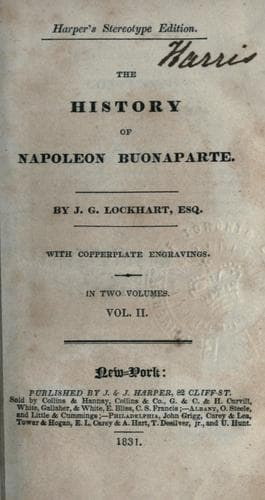
The History of Napoleon BuonaparteLockhart, J. G. (John Gibson)
History
The History of Napoleon Buonaparte
Lockhart, J. G. (John Gibson)
France -- Kings and rulers -- Biography; Napoleon I, Emperor of the French, 1769-1821
that would wish to see France dismembered. Let us avail ourselves of his
unrivalled talents in the war department, while he is willing to place
them at our command." All parties equally cried out against the
falsehood, duplicity, and, in fact, avowed profligacy of Fouché.
"Fouché," said Buonaparte, "and Fouché alone, is able to conduct the
ministry of the police: he alone has a perfect knowledge of all the
factions and intrigues which have been spreading misery through France.
We cannot create men: we must take such as we find; and it is easier to
modify by circumstances the feelings and conduct of an able servant,
than to supply his place." Thus did he systematically make use of
whatever was willing to be useful--counting on the ambition of one man,
the integrity of a second, and the avarice of a third, with equal
confidence; and justified, for the present time (which was all he was
anxious about) by the results of each of the experiments in question.
It is impossible to refuse the praise of consummate prudence and skill
to these, and indeed, to all the arrangements of Buonaparte, at this
great crisis of his history. The secret of his whole scheme is unfolded
in his own memorable words to Sieyes: "We are creating a new era,--of
the past we must forget the bad, and remember only the good." From the
day when the consular government was formed, a new epoch was to date.
Submit to that government, and no man need fear that his former acts,
far less opinions, should prove any obstacle to his security--nay, to
his advancement. Henceforth the regicide might dismiss all dread of
Bourbon revenge; the purchaser of forfeited property of being sacrificed
to the returning nobles; provided only they chose to sink their theories
and submit. To the royalist, on the other hand, Buonaparte held out the
prospect, not indeed of Bourbon restoration, but of the re-establishment
of a monarchical form of government, and all the concomitants of a
court; for the churchman the temples were at once opened; and the
rebuilding of the hierarchical fabric, in all its wealth, splendour and
power, was offered in prospective. Meanwhile, the great and crying evil,
from which the revolution had really sprung, was for ever abolished. The
odious distinction of castes was at an end. Political liberty existed,
perhaps, no longer; but civil liberty--the equality of all Frenchmen in
the eye of the law--was, or seemed to be, established. All men
henceforth must contribute to the state in the proportion of their
means: all men appeal to the same tribunals; and no man, however meanly
born, had it to say, that there was one post of power or dignity in
France to which talent and labour never could elevate him. Shortly after
Napoleon took possession of the Tuileries, _Murat_, who had long been
the lover of his sister Caroline, demanded her hand in marriage. The
gallantry and military talents of this handsome officer had already
Public-domain text, read in full here on John Shaqi.
Reviews
Reviews
No reviews yet
Be the first to share your thoughts on this work.
Elsewhere in the archive
Join the Discussion
Join the discussion
Sign in to leave a comment or review.
Sign InorCreate an account