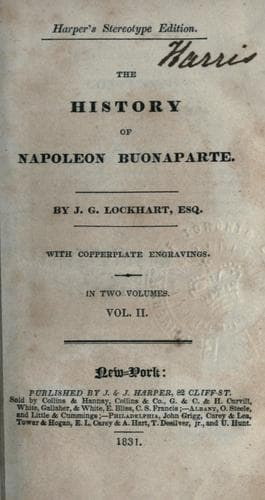
The History of Napoleon BuonaparteLockhart, J. G. (John Gibson)
History
The History of Napoleon Buonaparte
Lockhart, J. G. (John Gibson)
France -- Kings and rulers -- Biography; Napoleon I, Emperor of the French, 1769-1821
While the Austrians were thinking only of the frontier where Suchet
commanded an enfeebled and dispirited division,--destined, as they
doubted not, to be reinforced by the army, such as it was, of
Dijon,--the Chief Consul had resolved to penetrate into Italy, as
Hannibal had done of old, through all the dangers and difficulties of
the great Alps themselves. The march on the Var and Genoa might have
been executed with comparative ease, and might, in all likelihood, have
led to victory; but mere victory would not suffice. It was urgently
necessary that the name of Buonaparte should be surrounded with some
blaze of almost supernatural renown; and his plan for purchasing this
splendour was to rush down from the Alps, at whatever hazard, upon the
rear of Melas, cut off all his communications with Austria, and then
force him to a conflict, in which, Massena and Suchet being on the other
side of him, reverse must needs be ruin.
For the treble purpose of more easily collecting a sufficient stock of
provisions for the march, of making its accomplishment more rapid, and
of perplexing the enemy on its termination, Napoleon determined that his
army should pass in four divisions, by as many separate routes. The left
wing, under Moncey, consisting of 15,000 detached from the army of
Moreau, was ordered to debouch by the way of St. Gothard. The corps of
Thureau, 5000 strong, took the direction of Mount Cenis: that of
Chabran, of similar strength, moved by the Little St. Bernard. Of the
main body, consisting of 35,000, the Chief Consul himself took care;
and he reserved for them the gigantic task of surmounting, with the
artillery, the huge barriers of the Great St. Bernard. Thus along the
Alpine Chain--from the sources of the Rhine and the Rhone to Isere and
Durance--about 60,000 men, in all, prepared for the adventure. It must
be added, if we would form a fair conception of the enterprise, that
Napoleon well knew not one-third of these men had ever seen a shot fired
in earnest.
Public-domain text, read in full here on John Shaqi.
Reviews
Reviews
No reviews yet
Be the first to share your thoughts on this work.
Elsewhere in the archive
Join the Discussion
Join the discussion
Sign in to leave a comment or review.
Sign InorCreate an account