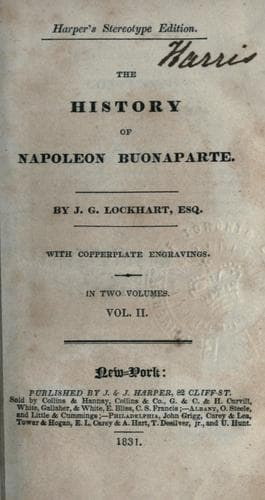
The History of Napoleon BuonaparteLockhart, J. G. (John Gibson)
History
The History of Napoleon Buonaparte
Lockhart, J. G. (John Gibson)
France -- Kings and rulers -- Biography; Napoleon I, Emperor of the French, 1769-1821
The discomfiture of the imperialists was so great, that rather than
stand the consequences of another battle, while Suchet was coming on
their rear, they next day entered into a negotiation. Melas offered to
abandon Genoa and all the strong places in Piedmont, Lombardy, and the
Legations--provided Buonaparte would allow him to march the remains of
his army unmolested to the rear of Mantua. Napoleon accepted this offer.
By one battle he had regained nearly all that the French had lost in the
unhappy Italian campaign of 1799: at all events he had done enough to
crown his own name with unrivalled splendour, and to show that the
French troops were once more what they had used to be--when he was in
the field to command them. He had another motive for closing with the
propositions of General Melas. It was of urgent importance to regain
Genoa, ere an English army, which he knew was on its voyage to that
port, could reach its destination.
On the 17th of June Napoleon returned in triumph to Milan, where he
formally re-established the Cisalpine Republic, and was present at a
festival of high state and magnificence. He then gave the command of the
army of Italy to Massena; and appointed Jourdan French minister in
Piedmont--in other words, governor of that dominion; and set out on his
journey to Paris. He halted at Lyons to lay the first stone of the new
_Place de Bellecour_, erected on the ruins of a great square destroyed
by the Jacobins during the revolutionary madness; and reached the
Tuileries on the 2nd of July. He had set out for Switzerland on the 6th
of May. Two months had not elapsed, and in that brief space what wonders
had been accomplished! The enthusiasm of the Parisians exceeded all that
has been recorded of any triumphal entry. Night after night every house
was illuminated; and day following day the people stood in crowds around
the palace, contented if they could but catch one glimpse of the
preserver of France.
The effusion of joy was the greater--because the tale of victory came on
a people prepared for other tidings. About noontide on the 14th of June,
when the French had been driven out of Marengo, and were apparently in
full and disastrous retreat, a commercial traveller left the field, and
arriving, after a rapid journey, in Paris, announced that Buonaparte had
been utterly defeated by Melas. It is said that the ill-wishers of the
First Consul immediately set on foot an intrigue for removing him from
the government, and investing Carnot with the chief authority. It is
not doubtful that many schemes of hostility had been agitated during
Napoleon's absence; or that, amidst all the clamour and splendour of his
triumphant reception in Paris, he wore a gloomy brow; nor has any one
disputed that, from this time, he regarded the person of Carnot with
jealousy and aversion.
Public-domain text, read in full here on John Shaqi.
Reviews
Reviews
No reviews yet
Be the first to share your thoughts on this work.
Elsewhere in the archive
Join the Discussion
Join the discussion
Sign in to leave a comment or review.
Sign InorCreate an account