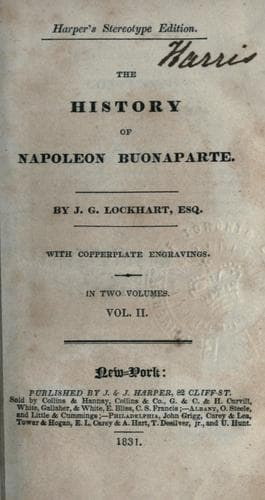
The History of Napoleon BuonaparteLockhart, J. G. (John Gibson)
History
The History of Napoleon Buonaparte
Lockhart, J. G. (John Gibson)
France -- Kings and rulers -- Biography; Napoleon I, Emperor of the French, 1769-1821
It has been already said that the half-crazy Emperor of Russia had taken
up a violent personal admiration for Buonaparte, and, under the
influence of that feeling, virtually abandoned Austria before the
campaign of Marengo. Napoleon took every means to flatter the Autocrat
and secure him in his interests. Paul had been pleased to appoint
himself Grand Master of the ruined Order of the Knights of St. John. It
was his not idle ambition to obtain, in this character, possession of
the Island of Malta; and Buonaparte represented the refusal of the
English government to give up that stronghold as a personal insult to
Paul. Some 10,000 Russian prisoners of war were not only sent back in
safety, but new clothed and equipped at the expense of France; and the
Autocrat was led to contrast this favourably with some alleged neglect
of these troops on the part of Austria, when arranging the treaty of
Luneville. Lastly, the Queen of Naples, sister to the German Emperor,
being satisfied that, after the battle of Marengo, nothing could save
her husband's Italian dominions from falling back into the hands of
France (out of which they had been rescued, during Napoleon's Egyptian
campaign, by the English, under Lord Nelson), took up the resolution of
travelling in person to St. Petersburg in the heart of the winter, and
soliciting the intercession of Paul. The Czar, egregiously flattered
with being invoked in this fashion, did not hesitate to apply in the
Queen's behalf to Buonaparte; and the Chief Consul, well calculating the
gain and the loss, consented to spare Naples for the present, thereby
completing the blind attachment of that weak-minded despot.
At the same time when Nelson delivered Naples from the French, a party
of English seamen, under Commodore Trowbridge, had landed at the mouth
of the Tiber, marched to Rome, and restored the Pope. The French army,
after the great victory which gave them back Lombardy and Piedmont,
doubted not that the re-establishment of "the Roman Republic" would be
one of its next consequences. But Buonaparte, who had in the interim
re-opened the churches of France, was now disposed to consider the
affairs of the Pope with very different eyes. In a word, he had already
resolved to make use of the Holy Father in the consolidation of his own
power as a monarch; and, as the first step to this object, the
government of the Pope was now suffered to continue--not a little to the
astonishment of the French soldiery, and to the confusion, it may be
added, and regret, of various powers of Europe.
Public-domain text, read in full here on John Shaqi.
Reviews
Reviews
No reviews yet
Be the first to share your thoughts on this work.
Elsewhere in the archive
Join the Discussion
Join the discussion
Sign in to leave a comment or review.
Sign InorCreate an account