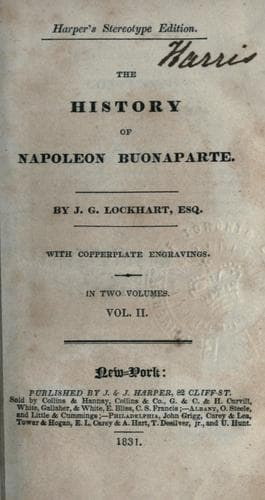
The History of Napoleon BuonaparteLockhart, J. G. (John Gibson)
History
The History of Napoleon Buonaparte
Lockhart, J. G. (John Gibson)
France -- Kings and rulers -- Biography; Napoleon I, Emperor of the French, 1769-1821
The successes of the English in the Baltic and in Egypt were well
calculated to dispose Napoleon for negotiation: and the retirement of
Mr. Pitt, who was considered throughout Europe as the author and very
soul of the anti-revolutionary war, was not without its influence. On
the other hand, Napoleon's mighty successes against the German emperor
had been followed up this same year by the march of a French and Spanish
army into Portugal, in consequence of which that last ally of England
had been compelled to submit to the general fate of the continent. On
both sides there existed the strongest motives for accommodation; and,
in effect, after a tedious negotiation, the preliminaries of peace were
signed, on the 10th of October, at Amiens. By this treaty England
surrendered all the conquests which she had made during the war, except
Ceylon and Trinidad. France, on the other hand, restored what she had
taken from Portugal, and guaranteed the independence of the Ionian
Islands. Malta was to be restored to the Knights of St. John, and
declared a free port: neither England nor France was to have any
representatives in the order; and the garrison was to consist of the
troops of a neutral power. This article was that which cost the greatest
difficulty--and Malta was destined to form the pretext, at least, for
the re-opening of the war at no distant date.
Meantime, except by a small party, who thought that England should never
make peace unless the Bourbon family were restored to the throne of
France, this news was received with universal satisfaction throughout
Great Britain. "It was," as Mr. Sheridan summed up the matter, "a peace
which all men were glad of, and of which no man could be proud." The
definitive treaty was signed on the 25th of March, 1802: and nothing
could surpass the demonstrations of joy on this occasion, both in London
and in Paris--or the enthusiastic display of good-will with which the
populace of either capital welcomed the plenipotentiaries.
[Footnote 41: For the details of the battle of Copenhagen see Southey's
_Life of Nelson_. That conflict has been celebrated, in a noble lyric,
by Campbell--
"Of Nelson and the North
Sing the glorious day's renown,
When to the battle fierce came forth
All the might of Denmark's crown," &c.
]
CHAPTER XVII
Peace of Amiens--The Concordat--The Legion of Honour--Buonaparte
President of the Cisalpine Republic--First Consul for Life--Grand
Mediator of the Helvetic Confederacy--St. Domingo--Toussaint
L'Ouverture--Dissatisfaction of England--Trial of Peltier--Lord
Whitworth--Rupture of the Peace of Amiens--Detention of English
Travellers in France.
Public-domain text, read in full here on John Shaqi.
Reviews
Reviews
No reviews yet
Be the first to share your thoughts on this work.
Elsewhere in the archive
Join the Discussion
Join the discussion
Sign in to leave a comment or review.
Sign InorCreate an account